In construction, what gets celebrated is often what can be seen – glass towers rising against the skyline, infrastructure reshaping cities, and projects that symbolize economic ambition at its peak. Yet the true weight of the industry rarely sits in what is visible. It exists in decisions made long before ground is broken and long after structures are completed – decisions that determine financial resilience, investor confidence, operational alignment, and ultimately whether ambition translates into enduring value.
This is where leadership carries its greatest responsibility. Because in an industry where billions are committed on forecasts, contracts evolve mid-execution, and timelines remain under constant pressure, success is not simply about delivery – it is about judgment. The ability to assess risk with clarity, align stakeholders with competing priorities, and make decisions that hold up not just at completion, but across the full lifecycle of an asset.
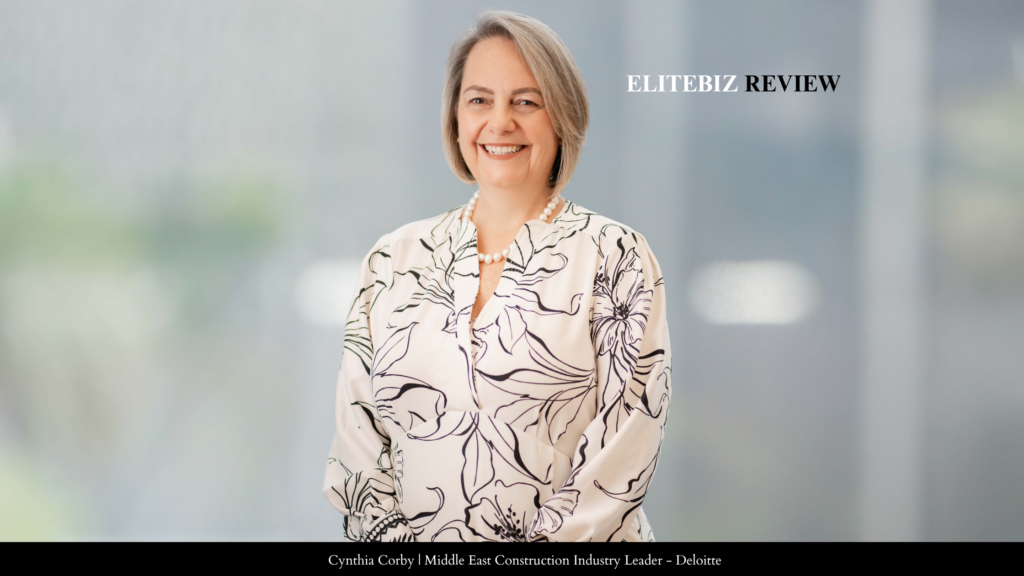
Few professionals operate at this level of influence as consistently as Cynthia Corby. As the Middle East Construction Industry Leader at Deloitte and Construction Chair at the British Chamber of Commerce Dubai, Corby has spent over three decades working at the intersection of finance, strategy, and construction. Her career has placed her inside boardrooms where critical decisions are made, and on project sites where those decisions are tested in real time – bridging strategy with execution, and financial theory with operational reality.
Her work is not defined by individual projects, but by the systems that shape them – how industries think, how organizations align, and how leadership evolves in response to increasing complexity. In a region like Dubai, where construction is not just an industry but a defining force of economic identity, that perspective becomes especially significant. Here, projects are rarely incremental. They are ambitious, fast-paced, and often unprecedented. Behind that ambition lies a need for leadership that is not only technically sound, but structurally aware of how decisions ripple across an entire ecosystem.
Corby’s career has been built within exactly that environment – where scale intensifies complexity, and where the margin for error is measured not just in cost, but in credibility.
A Career Shaped at the Intersection of Finance, Strategy, and Scale
Cynthia Corby’s professional journey is rooted in more than 30 years of working alongside Boards, executive teams, and industry leaders across multiple geographies, including the UK, the Middle East, and South Africa. This breadth of exposure has shaped a perspective grounded not just in technical expertise, but in governance, strategic advisory, and financial oversight at the highest levels.
Yet it was within the construction sector that these disciplines converged in their most demanding form. “The construction sector captured my interest because of its complexity,” she reflects. What drew her in was not only the scale of projects, but the layered challenges they presented – where engineering ambition, financial discipline, and strategic coordination must operate in sync.
Dubai played a pivotal role in that journey. Over the past two decades, the city has become a global stage for some of the most ambitious infrastructure and real estate developments ever undertaken. For Corby, witnessing these projects unfold offered more than inspiration – it provided a deeper understanding of the intricate systems required to deliver them successfully.
“Watching some of the world’s most iconic and challenging projects being deciphered and built here captured my creative interests, while the critical role that construction plays in the economic development of the country captured my financial and strategic interests.”
Her work leading audits for major construction firms and advising large government developers placed her at the center of these realities. It revealed not just opportunities, but also the vulnerabilities – where misalignment, late-stage design changes, or financial misjudgments could significantly alter outcomes. This experience shaped a leadership philosophy grounded in clarity and foresight.
“It has shaped my leadership perspective to be pragmatic and solution-focused, with a large emphasis on collaboration, resilience, and strategic foresight to drive sustainable growth through a continuous pursuit for excellence.”
Rather than treating leadership as a position, Corby approaches it as a responsibility to bring structure to complexity and enable better decision-making across every stage of a project.
Leading Through Cycles of Disruption and Change
Construction is an industry defined as much by its disruptions as by its achievements. Over the past two decades, Corby has experienced these cycles firsthand in Dubai, where rapid development has been accompanied by equally significant economic and global challenges.
From the Global Financial Crisis to the COVID-19 pandemic and ongoing geopolitical tensions, each phase has reshaped how projects are financed, managed, and delivered.
“Operating in such a dynamic environment has required exceptional program management at scale, alongside continuous problem-solving to bring complex visions to life.”
These periods of disruption revealed deeper structural issues within the industry. During the Global Financial Crisis, for instance, international contractors delivering large-scale projects faced immense pressure on both demand and cash flow. Financial reporting became increasingly complex, particularly in areas such as recoverability, contractual claims, and risk visibility.
These challenges were not confined to finance – they directly influenced investor confidence, project continuity, and market stability. At the same time, inefficiencies across the industry became more visible. Project delays, evolving designs introduced too late in the lifecycle, and misaligned stakeholder priorities often resulted in avoidable cost overruns and disputes.
“They highlighted systemic issues across the industry, including significant project variations, delays, and the impact of evolving designs at scale.”
In response, Corby played an active role in advancing industry dialogue. Through her involvement with the British Chamber of Commerce Dubai, she has contributed to discussions, roundtables, and collaborative initiatives alongside senior industry leaders and CEOs of major contracting firms. These platforms have helped surface critical challenges and push for more coordinated, forward-looking approaches across the sector.
A More Integrated Approach to Construction Leadership
One of the most persistent challenges in construction is fragmentation. Developers, contractors, consultants, and investors often operate within their own priorities, resulting in decisions made in isolation rather than alignment. The impact is cumulative – inefficiencies increase, risks escalate, and long-term value is compromised. Corby’s approach focuses on addressing this disconnect at its root.
“Visionary leadership is about seeing beyond established processes and short-term delivery to shape how the industry evolves, while still executing reliably at scale.”
Her work emphasizes the importance of integration across the full lifecycle of a project – from feasibility and design through to execution and long-term asset management. Encouraging collaboration at earlier stages allows stakeholders to align expectations, improve decision-making, and reduce inefficiencies before they escalate into larger challenges.
“This involves encouraging early collaboration to improve decision-making, enhance project outcomes, and ensure that investments deliver their intended return – not only financially, but also commercially through the longevity of the investment.”
This perspective shifts the focus from isolated milestones to sustained value creation. It also underpins ongoing efforts within industry forums to develop more structured approaches – often discussed as potential “playbooks” – that can guide stakeholders toward more aligned and predictable outcomes.
An Industry Being Reshaped by Technology and Sustainability
The construction sector is undergoing a fundamental transformation driven by digitalization, industrialization, and sustainability. These forces are not simply influencing how projects are delivered – they are reshaping how the entire industry operates.
There is an evolving vision for projects to become data-driven ecosystems. Technologies such as AI and digital platforms are enabling more predictive and integrated decision-making, which is fully embraced in the industry would allow leaders across all stakeholders to evaluate the available data in real time to anticipate risks, optimize resources, and improve outcomes across the project lifecycle.
This evolution will change the nature of leadership itself. It requires a shift from managing isolated tasks to overseeing interconnected systems where data, operations, and strategy must align seamlessly and is fully transparent to all stakeholders.
At the same time, traditional construction models are evolving. Modular and offsite manufacturing approaches are gaining traction, improving efficiency while addressing labour shortages and reducing reliance on conventional site-based methods. Sustainability has also moved from a secondary consideration to a central priority.
“There is a growing emphasis on sustainability and whole-life value, requiring leaders to balance financial, environmental, and commercial outcomes.”
These shifts are breaking down traditional boundaries and demanding greater collaboration across stakeholders. Leaders must now navigate a more complex landscape – one that requires adaptability, foresight, and a willingness to embrace change without compromising reliability.
Balancing Financial Integrity with Operational Reality
At the heart of construction leadership lies financial decision-making. Large-scale projects involve significant levels of management judgment, particularly in areas such as revenue recognition, cost forecasting, and project timelines. “These judgments can materially impact reported performance and investor confidence.”
Corby’s approach emphasizes the importance of grounding these decisions in operational reality. “This includes spending time on-site with project directors to fully understand the operational realities and risks they are managing.” By combining technical expertise with firsthand insight, she is able to challenge assumptions constructively and guide organizations toward more accurate, transparent reporting.
This alignment between financial oversight and operational truth is critical. It not only improves clarity but also strengthens trust among stakeholders – an essential factor in an industry where credibility directly influences long-term success.
Beyond individual engagements, her work continues to support broader industry improvement through collaboration, thought leadership, and the advancement of more integrated approaches to project planning and execution.
The Responsibility That Comes with Influence
Recognition as one of “The Most Visionary Builders Defining the Future of Construction – 2026” reflects the scale of Corby’s influence within the industry. With that influence comes a broader responsibility. “Visionary leaders shape the standards, behaviors, and long-term sustainability of the entire ecosystem.”
This responsibility extends beyond being part of the eco system that is responsible for delivering successful projects. “Visionary leaders have a responsibility to set the tone for transparency, discipline, and integrity in financial reporting.”
Equally important is the responsibility to address structural challenges within the industry, including fragmentation and short-term thinking. By encouraging collaboration and aligning stakeholders around shared objectives, leaders can help build a more cohesive and resilient ecosystem. Leadership at this level is not defined by authority alone, but by the ability to influence how the industry evolves over time.
Guidance for Emerging Professionals
For emerging professionals looking to build meaningful careers, Corby emphasizes qualities that extend beyond technical expertise. “Stay curious. Don’t limit yourself to your immediate role.”
Understanding how decisions are made, how value is created, and how different parts of the business interact is essential for long-term growth and impact. Authenticity also plays a critical role. “Authenticity builds trust, and that trust becomes one of your most valuable assets over time.”
In an industry where relationships and credibility matter, this trust becomes a defining advantage. Equally important is a commitment to continuous learning. “Learning shouldn’t be seen as a phase early in your career, but as a constant throughout it.” In a sector that is constantly evolving, those who invest in their development are better positioned to adapt, lead, and create value.
A Legacy Built on Long-Term Value and Trust
Looking ahead, Corby’s vision is centered on shaping an industry that is more transparent, collaborative, and focused on long-term value. “Greater transparency, collaboration, and long-term value creation for end users and investors.”
This includes strengthening consistency in financial reporting, improving stakeholder alignment, and leveraging technology to enhance decision-making across the project lifecycle. It also involves addressing long-standing inefficiencies caused by fragmented approaches and misaligned incentives – areas where even incremental improvements can create significant impact.
Ultimately, her legacy is not defined by individual achievements, but by the broader transformation of the industry. “Industries don’t transform through strategy alone; they transform through the people who lead them by example.” In a sector where decisions shape not only projects but also economies and communities, that kind of leadership carries lasting significance.