In the world of smart homes and property technology, innovation is often associated with visibility – sleek devices, connected ecosystems, intelligent dashboards, and sophisticated automation systems designed to make modern living feel effortless. Yet, the most meaningful progress rarely comes from what is seen most clearly. It comes from what works quietly in the background: systems that simplify rather than complicate, technology that adapts naturally to human behavior, and solutions that improve everyday life without demanding constant attention.
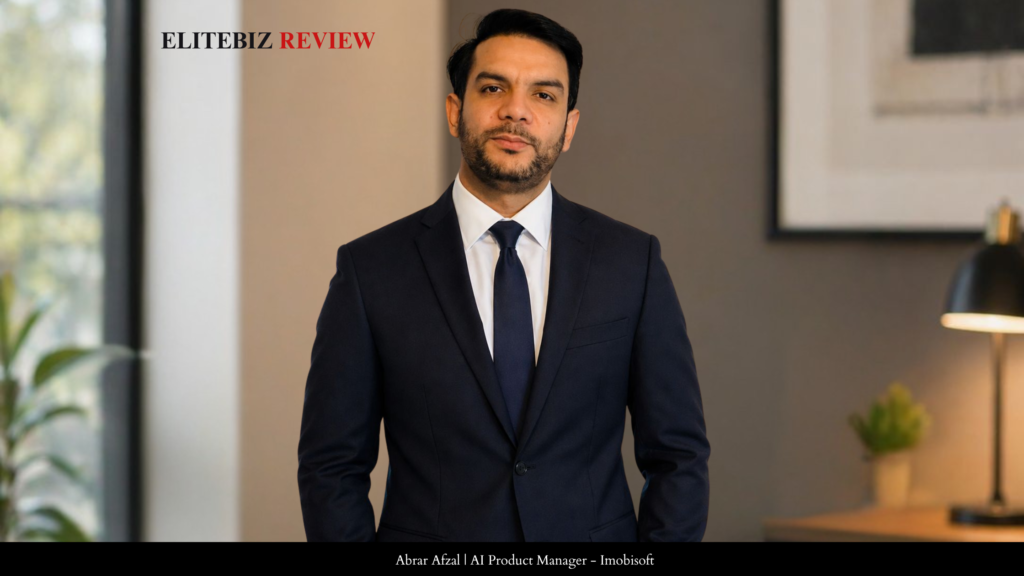
This philosophy defines Abrar Afzal, AI Product Manager at Imobisoft. Working at the intersection of artificial intelligence, SaaS delivery, product strategy, and user experience, Abrar has built his career around one powerful belief – that technology should serve people so seamlessly that it feels almost invisible.
At a time when industries are rushing to adopt AI as a symbol of progress, his perspective stands apart for its clarity and restraint. He does not see smart homes as collections of connected devices or impressive dashboards. Instead, he sees them as living environments where technology must work in harmony with human routines, privacy expectations, and real-world needs. Smart systems should not feel like technology experiments; they should feel like better homes.
His work reflects a larger shift happening across PropTech: a move away from complexity for complexity’s sake and toward thoughtful, human-centered innovation. From AI-driven SaaS platforms to privacy-first edge computing and local AI architecture, Abrar is helping shape a future where trust, simplicity, and usability matter just as much as technological advancement.
Featured in The Most Influential Smart Home & PropTech Leaders – 2026, he represents a new kind of leadership – one grounded not in louder innovation, but in smarter, more responsible design.
From Systems Thinking to Human-Centered Innovation
Abrar’s journey into AI-driven SaaS delivery and product management was not the result of a fixed career plan. It evolved gradually, shaped by curiosity, problem-solving, and a long-standing interest in understanding how systems work – and how they can work better.
Early in his career, he naturally gravitated toward roles that sat between business needs and technical execution. Rather than choosing a path rooted only in engineering or purely in strategy, he found himself drawn to the space where both worlds met – the place where ideas had to become outcomes.
That perspective became the foundation of his leadership philosophy. It was never enough to understand how something worked; the real question was whether it could solve a meaningful problem and create genuine value for the people using it.
As he moved deeper into AI-driven SaaS environments, this mindset became sharper. He saw firsthand how powerful data, automation, and machine learning could be in transforming operations and decision-making. At the same time, he also recognized how easily innovation could become disconnected from real user needs.
That realization became a defining turning point. In sectors like smart homes and PropTech, where technology directly shapes how people live and work, over-engineering can quickly create frustration instead of convenience. Users do not want systems that feel invasive or overly technical – they want environments that feel intuitive and naturally supportive.
This is why Abrar’s approach has remained rooted in one principle: building systems that quietly enhance environments rather than dominate them. His focus has never been on creating technology that demands attention, but on designing intelligence that earns trust by making life easier.
From Automation to Intelligence
The idea of the smart home has changed dramatically over the last decade. What once referred to remote-controlled lights, scheduled automation, and app-managed security is now evolving into something far more sophisticated – intelligent environments capable of understanding context, learning patterns, and responding proactively.
Traditionally, smart home systems were built around control. They waited for instructions. Users could switch devices on and off remotely, automate routines, and access systems from anywhere, but these solutions remained largely reactive.
The next generation of smart living is different. With artificial intelligence integrated into homes and buildings, systems are beginning to move beyond execution and into understanding. They can learn usage patterns, identify inefficiencies, predict behavior, and make decisions based on context rather than commands.
Heating systems can respond to occupancy habits, energy usage can adjust based on behavioral trends, and security systems can operate with greater awareness and precision. This is where technology moves from convenience to intelligence.
Much of this progress has been enabled by AI combined with cloud infrastructure. Cloud platforms offer scalability, remote access, and centralized intelligence. But Abrar has increasingly begun questioning the assumption that all intelligence must be cloud-dependent.
A recent project at Imobisoft reshaped that thinking. His team is developing a smart home solution built on a secure Raspberry Pi architecture, where the AI model runs locally on the device instead of relying on constant internet connectivity.
This project revealed something important: intelligence does not always need to be centralized to be powerful. Local AI creates stronger privacy, lower latency, and better reliability. Decisions happen faster because they do not need to travel to external servers and back, and systems remain functional even without uninterrupted connectivity.
It also strengthens trust. In connected living spaces, privacy is not a feature – it is a requirement.
Abrar believes the future will be hybrid. Cloud infrastructure will continue to support scalability, updates, and broader insights, while more operational intelligence moves closer to the device itself. Homes and buildings will become more autonomous, capable of making decisions independently.
That is where smart technology becomes truly transformative – when it becomes both smarter and more independent.
Building Systems That Scale Without Creating Complexity
One of the biggest misconceptions in smart home innovation is the belief that better products come from adding more features, more controls, and more visible sophistication. In reality, Abrar believes the opposite is often true. People do not want complexity. They want simplicity.
For him, every successful project begins with clarity. Before teams discuss integrations, features, or technical frameworks, they must answer one critical question: what problem are we actually solving?
Without that clarity, products often become technically impressive but practically frustrating. Complexity gets mistaken for innovation, and users are left with systems that demand more effort instead of removing it.
In residential and commercial spaces, the expectation is simple: the system should adapt to the user, not the other way around. Technology should reduce friction, not create another layer of management.
This becomes even more important when scalability enters the picture. Smart home ecosystems rarely exist in isolation. They involve multiple devices, third-party integrations, sensors, and continuous data flows. Without strong architectural planning from the beginning, even promising solutions become difficult to maintain or expand.
A system may work well at launch, but poor architecture creates long-term operational debt – problems that only surface when growth begins. Data management is equally critical. AI depends on good data, but success is not simply about collecting information. It is about how data flows through the system, how it is structured, and how responsibly it is used. Poor data creates poor intelligence, regardless of how advanced the model may be.
Yet many delivery challenges are not technical at all. In Abrar’s experience, the biggest obstacles often come from misalignment – unclear priorities, disconnected teams, or a lack of shared direction. Alignment between product teams, engineering teams, and stakeholders is often the real difference between successful execution and stalled delivery.
The Future of PropTech Belongs to Connected Ecosystems
As smart technologies continue to reshape residential and commercial spaces, one of the most important shifts in PropTech is not simply the adoption of more technology, but the way that technology is being structured.
For years, the industry relied on disconnected tools solving disconnected problems – one platform for operations, another for analytics, another for tenant experience, and separate systems for maintenance, sustainability, and asset performance. That model is changing.
Organizations are moving toward integrated ecosystems where operations, analytics, sustainability, user experience, and strategic decision-making exist within a single connected framework. Technology is no longer a support function sitting beside business operations; it becomes part of the operational core.
Another major shift is the rise of data-driven decision-making. Property management has traditionally relied heavily on experience and intuition. While expertise remains essential, data now provides a level of precision and visibility that allows faster, smarter decisions – from predictive maintenance and occupancy trends to tenant behavior and operational efficiency.
Sustainability is also becoming central to this transformation. It is no longer treated as a separate initiative but as a built-in part of how properties are designed and managed. Technology is increasingly judged not only by convenience or performance, but by how effectively it improves efficiency while reducing environmental impact.
Abrar also sees edge computing playing a bigger role. Not everything needs to be processed in the cloud. Local processing improves speed, reduces dependency, strengthens privacy, and creates stronger resilience. The future of PropTech will not belong to isolated smart devices. It will belong to intelligent infrastructure.
Why AI Adoption Often Fails
Despite the growing enthusiasm around AI-powered smart home technologies, implementation remains one of the most misunderstood challenges organizations face. Many businesses treat AI as though it can simply be added to an existing process and immediately create transformation. In reality, AI depends on strong foundations.
The first issue is usually data. In many cases, data is fragmented, inconsistent, or not structured in a way AI can effectively use. If the foundation is weak, even the strongest models struggle to deliver useful outcomes.
Integration is the second major challenge. Smart home environments involve multiple devices, vendors, and systems, each with different requirements. Bringing them together into a seamless experience is far more complex than many organizations anticipate.
Privacy adds another major barrier. As connected devices enter increasingly personal spaces like homes, users become far more aware of how their data is collected and used. This is not simply a technical issue – it is a trust issue.
This is one reason Abrar places strong emphasis on local AI architecture. By allowing intelligence to run on-device rather than relying entirely on cloud systems, privacy concerns are reduced and user confidence improves.
He also believes organizations often make the mistake of aiming too high too quickly. Trying to implement highly advanced AI from day one can create unnecessary complexity and slow adoption. Focused, high-impact use cases often create better long-term results than oversized transformation projects. Successful AI implementation is less about ambition and more about discipline.
Bridging Vision and Execution
In PropTech, project and product managers often play one of the most critical yet underestimated roles. They are the bridge between innovation and execution, between technical capability and business reality.
For Abrar, alignment is one of the most important responsibilities in that role. It starts with a clear vision and making sure everyone understands what success actually looks like. Without shared direction, even strong teams lose focus. From there, communication becomes the operating system of delivery.
Different teams naturally prioritize different things. Business stakeholders focus on outcomes, engineers focus on feasibility, and product teams focus on usability. Users, meanwhile, care only about whether the product improves their experience.
Bringing those perspectives together requires constant translation. A major part of Abrar’s role is ensuring stakeholders understand the value of what is being built while helping technical teams stay connected to real-world business outcomes.
User feedback remains essential throughout the process. It keeps products grounded and prevents innovation from becoming disconnected from actual needs. Strong products are built where innovation meets practicality – and where leadership is defined by balance.
Privacy, Security, and the Foundation of Trust
In connected living environments, privacy and cybersecurity are not optional features. They are the foundation of trust. As homes become more intelligent and more connected, users are increasingly aware of how their personal data is handled. If people do not feel comfortable, they will not fully adopt the technology – regardless of how advanced it may be.
This is one reason edge-based solutions are becoming increasingly important. When data stays local and systems do not rely on constant internet connectivity, the risk surface becomes smaller. But architecture alone is not enough. Security must be built into every layer – from encrypted data and secure infrastructure to controlled access and continuous monitoring.
Transparency matters just as much. Users should understand what data is being used, why it is needed, and how it improves their experience. Clarity builds confidence. Confusion weakens trust. In connected environments, trust is everything – and without trust, even the smartest systems fail.
A Future Grounded in Purpose
Among the projects that shaped Abrar’s professional journey, one stands out most: the development of a smart home solution built around a Raspberry Pi with an on-device AI model.
It challenged conventional assumptions about how AI systems should be designed. Instead of relying heavily on cloud infrastructure, the team had to deliver meaningful intelligence within a constrained environment while maintaining performance, usability, and privacy.
That experience reinforced a lesson that continues to shape his leadership philosophy: the best solutions are not always the most complex – they are the most thoughtful.
The same belief shapes the advice he offers to emerging professionals entering smart home technology and PropTech. Focus on understanding real problems before rushing toward solutions. Technology changes quickly, but real-world challenges remain surprisingly consistent.
He also emphasizes curiosity, continuous learning, and communication as essential skills. The ability to connect ideas across teams and explain concepts clearly often creates more impact than technical expertise alone.
Above all, responsibility matters. As smart environments become more intelligent, professionals are not simply building products – they are shaping how people live, trust, and interact with technology every day.
At the heart of Abrar’s work lies a simple belief: innovation only matters when it creates real, practical value. Whether it is improving efficiency, simplifying processes, reducing waste, or creating better everyday experiences, success is measured by impact – not complexity.
“The future of smart homes and PropTech is exciting,” he reflects, “but the real success will come from solutions that stay grounded – focused on people, not just technology.” Because the future of intelligent living will not be defined by how advanced technology becomes. It will be defined by how naturally that intelligence fits into human life.