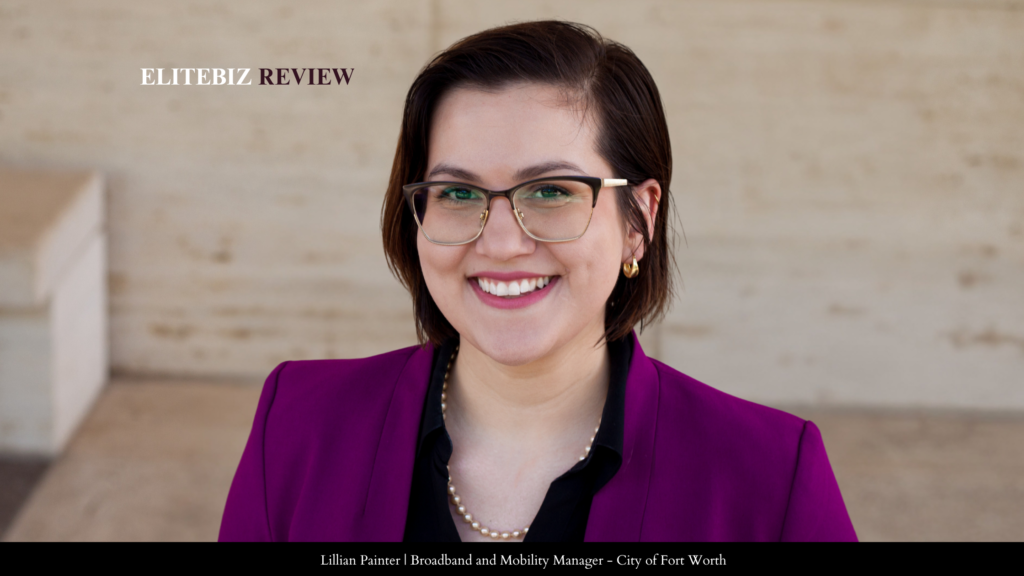

Most people avoid complicated systems. Lillian Painter built a career around them. Long before broadband became central to national conversations around digital equity, economic resilience, and smart infrastructure, Lillian was already drawn toward the kinds of challenges many others hesitated to approach. Telecommunications, broadband planning, mobility systems, governance structures, operational coordination, and public infrastructure all existed within a space that demanded patience, adaptability, and an unusual willingness to navigate complexity without losing sight of the people affected by it.
What interested her was never simply the technology itself. “I have always been drawn to projects that other people find difficult to approach or even dislike,” she says. That mindset would eventually shape a leadership journey rooted not in visibility or self promotion, but in thoughtful problem solving, public service, and long term community impact. Today, as Broadband and Mobility Manager for the City of Fort Worth, Lillian operates at the intersection of infrastructure, operations, connectivity strategy, governance, and digital transformation.
Her work spans municipal fiber deployment, enterprise mobility, digital inclusion initiatives, smart city planning, and the operational systems that help modern cities function more effectively behind the scenes. Yet despite the increasingly technical nature of the field, her perspective remains remarkably grounded.
She approaches connectivity not simply as a telecommunications issue, but as a public infrastructure issue, an economic development issue, and ultimately, a human issue. That distinction defines much of her leadership philosophy. In a world where digital systems increasingly shape how communities learn, work, communicate, access services, and respond during emergencies, Lillian believes connectivity must be approached with the same seriousness as any other foundational public infrastructure. And as cities continue becoming more digitally dependent, that perspective is proving more important than ever.
A Leadership Path Shaped by Public Service
Unlike many professionals in telecommunications, Lillian did not enter the industry through a traditional engineering or technical pathway. Her professional background is rooted in public administration, policy, finance, federal grants, and local government management. That multidisciplinary foundation ultimately became one of her greatest strengths.
When she first volunteered to take on broadband related work, the field already carried a reputation for being highly technical, fragmented, and difficult to navigate. Infrastructure planning, federal funding structures, operational coordination, deployment logistics, and technical terminology often created barriers even within government environments. Some of those perceptions, she admits, were fair.
At the same time, however, she discovered a field filled with highly intelligent professionals genuinely committed to solving difficult problems and improving communities through connectivity.
Her understanding of broadband deepened significantly during her time at Dallas County, particularly during the early stages of the COVID 19 pandemic. That period fundamentally reshaped how governments across the country viewed internet access and digital infrastructure.
Communities suddenly depended on reliable connectivity for healthcare access, remote work, online education, emergency communication, and essential government services. The pandemic exposed just how deeply internet access influenced educational opportunity, workforce participation, economic resilience, and quality of life.
“It became clear to me very quickly that internet access is not a luxury,” Lillian explains. That realization transformed the way she approached telecommunications leadership. Broadband was no longer simply a technology discussion. It had become directly connected to opportunity itself.
Her current role with the City of Fort Worth builds directly upon that understanding. Working across both broadband and mobility initiatives, she helps support an operational ecosystem designed to remain resilient, secure, responsive, and adaptable as cities continue evolving.
Broadband infrastructure creates the foundation. Mobility supports the devices, field technologies, cellular services, and connected operational tools city employees rely on every day. Together, those systems help strengthen public safety, improve municipal operations, and support more connected city services.
Defining Influence Beyond Formal Authority
Within public sector telecommunications, influence rarely comes from hierarchy alone. For Lillian, influence means helping people understand what connectivity makes possible and creating opportunities for collaboration that improve the long term quality of life within communities.
“In local government, influence is not always about formal authority,” she says. That perspective reflects the collaborative reality of broadband and mobility work, where success depends heavily on relationship building, communication, and the ability to bridge highly technical conversations with practical human outcomes.
Fiber networks, grant strategies, mobility governance, infrastructure planning, cybersecurity considerations, and digital systems can quickly become overwhelming subjects for nontechnical audiences. Yet the impacts of those systems are deeply tangible.
A municipal fiber network may determine whether city operations remain reliable during emergencies. Mobility infrastructure may influence whether firefighters and field teams can communicate effectively in real time. Connectivity policies may affect whether residents can access services efficiently and securely.
For Lillian, influence involves helping connectivity be recognized as foundational infrastructure rather than a temporary technological trend. “It is a necessary condition that increasingly underpins daily life,” she explains.
That philosophy also shapes the way she approaches conversations surrounding sustainability, equity, operational resilience, cybersecurity, and long term public benefit. Rather than treating those priorities as competing interests, she believes they must remain connected within every major infrastructure discussion. Her ability to navigate those layered conversations thoughtfully and calmly has become one of her defining strengths as a leader.
Strengthening the Infrastructure Behind a Growing City
One of the most significant initiatives Lillian supports is Fort Worth’s citywide municipal fiber network, a transformative infrastructure effort designed to strengthen connectivity across municipal operations while supporting future community investment.
At full scale, the network includes approximately 300 linear miles of fiber, connects more than 190 municipal facilities, and passes over 90,000 homes.
Projects of this scale involve far more than construction alone. Funding coordination, infrastructure planning, activation sequencing, testing, operational oversight, network design, stakeholder communication, and long term sustainability all exist simultaneously within large scale broadband initiatives.
One of Lillian’s most important responsibilities involves helping different audiences understand that complexity clearly. “Large fiber projects rarely move in a simple, linear way,” she explains.
Construction segments, network rings, funding timelines, testing phases, and activation processes each operate according to their own operational logic. Helping decision makers, departments, and the public understand those moving parts has become a critical aspect of her work.
That ability to translate between technical and nontechnical environments reflects one of her strongest leadership qualities. Rather than oversimplifying complicated systems, she works to create clarity while preserving nuance.
Alongside broadband infrastructure leadership, Lillian also manages the City’s enterprise mobility program, supporting a wide range of connected technologies including phones, tablets, routers, laptops, cameras, and other cellular enabled devices used throughout municipal operations.
These systems directly support public safety teams, fleet services, field operations, and departments operating across Fort Worth’s growing urban ecosystem.
She is also currently leading a mobility optimization effort that could potentially save the City approximately half a million dollars annually if fully realized.
For Lillian, that initiative reflects an important principle of responsible public sector leadership: improving operational effectiveness and being a thoughtful steward of public resources should exist together.
Technology investments, in her view, should strengthen security, improve service delivery, support sustainability, and maximize long term value simultaneously.
Looking Beyond Coverage Maps to Address the Digital Divide
While broadband deployment remains critical, Lillian approaches digital inclusion through a much broader lens than infrastructure availability alone. “The digital divide is multifaceted,” she explains.
Connectivity is influenced by far more than whether service technically exists in a neighborhood. Affordability, digital literacy, device availability, transportation barriers, language accessibility, trust, and awareness all shape whether individuals can participate meaningfully within an increasingly digital society.
That understanding has shaped the way she approaches broadband strategy and community engagement efforts throughout her work.
Cities, she believes, cannot solve every aspect of digital inequity independently. However, local government can play an important role in aligning public assets, service providers, regional funding, nonprofits, schools, libraries, and community organizations around shared goals.
Her perspective on connectivity is also closely tied to broader conversations surrounding quality of life and social determinants of health.
Lillian often considers broadband in relation to transportation and accessibility. Reliable internet access can reduce barriers by allowing residents to participate in telehealth appointments, online education, remote work opportunities, digital access to benefits, and civic engagement without always requiring physical travel.
This does not replace transportation infrastructure entirely, but it expands flexibility and creates more pathways to opportunity.
Most importantly, she believes equitable connectivity cannot be approached through assumptions alone. “Equitable connectivity requires more than a buildout map,” she says.
Real progress requires listening directly to the communities most affected, understanding the practical barriers they experience, and designing solutions grounded in lived reality rather than theoretical planning.
Bridging Conversations Across Public and Private Sectors
Public sector telecommunications leadership requires balancing a remarkably wide range of perspectives simultaneously. Elected officials, engineers, service providers, community organizations, vendors, internal departments, frontline staff, and residents often approach connectivity initiatives from entirely different operational realities.
Lillian begins those conversations with a simple belief: everyone brings valuable expertise and lived experience to the table.
Private sector providers may focus on construction realities, operational feasibility, and long term sustainability. Internal departments may prioritize continuity, security, reliability, and budget management. Community members may simply want to know whether projects will improve their daily lives in practical ways.
Building alignment requires taking all of those perspectives seriously. “A lot of my work is about bridging those conversations without oversimplifying them,” she explains.
Her leadership style reflects intellectual curiosity, patience, and a calm steadiness that allows complex conversations to remain productive even when priorities differ. Rather than forcing quick consensus, she works to identify the shared outcomes underneath varying perspectives.
In broadband and mobility initiatives, those shared outcomes often center around reliable, secure, sustainable connectivity that allows communities and organizations to function more effectively.
That ability to translate between technical and nontechnical stakeholders has become increasingly valuable as cities continue expanding digital infrastructure and connected services.
Leadership, Change, and the Human Side of Infrastructure
Despite the highly technical nature of telecommunications, Lillian believes the most difficult challenges within public sector technology work are often human rather than operational.
“Public sector technology work is rarely just technical,” she says.
Projects are shaped by public perception, institutional habits, funding limitations, competing priorities, varying degrees of risk tolerance, and discomfort surrounding change itself.
Even misinformation or poorly researched public commentary can influence how infrastructure projects are perceived, making communication and trust building critically important throughout implementation. Those experiences have strongly shaped Lillian’s leadership philosophy over time.
One of the most important lessons she has learned is that effective leadership cannot be built around avoiding difficult conversations or trying to satisfy everyone simultaneously.
“You cannot people please your way into effective leadership,” she explains. The strongest leaders she has worked alongside, she says, balance candor with compassion. They remain honest and steady while still caring deeply about the people affected by decisions.
That same balance shapes her own leadership approach. She strives to remain responsive rather than reactive, calm during uncertainty, and clear without becoming dismissive.
There is a quiet discipline to the way she navigates complexity, one rooted less in urgency and more in thoughtful decision making. In environments where infrastructure, operations, technology, and public expectations intersect constantly, that steadiness becomes essential.
Preparing Cities for What Comes Next
As cities continue evolving, Lillian believes telecommunications infrastructure will play an increasingly central role in how communities operate, grow, and respond to future challenges.
She expects broadband to continue being recognized as essential infrastructure supporting economic development, emergency response, education, transportation, healthcare access, and government services.
At the same time, mobility and IoT systems will continue expanding across municipal operations. Public safety teams, fleet services, connected cameras, facilities, field devices, and operational systems will rely more heavily on secure and reliable mobile connectivity.
That growth, she believes, will make governance, lifecycle management, cybersecurity, operational sustainability, and responsible data practices even more important.
Lillian also believes digital inclusion must remain central to future technology deployment and adoption strategies.
Infrastructure alone, she argues, will not solve digital inequity if communities still face barriers related to affordability, devices, digital literacy, or trust.
Beyond telecommunications itself, she also anticipates growing conversations surrounding the infrastructure dependencies supporting digital transformation, particularly energy systems.
As energy demand continues rising alongside connected infrastructure, communities will need resilient, sustainable, and cost effective energy systems capable of supporting long term growth.
“Innovative city systems are built upon resilient infrastructure,” she explains.
The cities best positioned for future growth, in her view, will be the ones willing to plan strategically across those interconnected systems rather than treating them as isolated conversations.
Advice for the Next Generation of Infrastructure Leaders
For professionals aspiring to make meaningful impact within telecommunications and public infrastructure, Lillian’s advice is both practical and deeply grounded in experience. Stay curious. Stay grounded. Learn how to communicate across disciplines.
Telecommunications may be highly technical, but public infrastructure is ultimately about people. The strongest leaders understand both the systems themselves and the human impact those systems create.
Lillian encourages emerging professionals to build fluency across multiple areas including policy, cybersecurity, funding, procurement, construction, governance, operations, and community engagement. While no one can master every discipline, understanding how those systems connect is essential for effective leadership. She also emphasizes the importance of patience and persistence.
Meaningful infrastructure work, she believes, often happens quietly through coordination, documentation, operational planning, alignment, and long term investment. Those responsibilities may not always appear glamorous, but they are what transform ideas into functioning systems capable of lasting impact.
She is also cautious about the pressure organizations sometimes feel to adopt emerging technologies too quickly. In practice, she believes cities are better served by thoughtful, methodical approaches to innovation rather than rushing toward adoption before governance, infrastructure, operational support, or security frameworks are fully prepared.
Most importantly, she believes connectivity should always be understood through the lens of opportunity. Whether the work involves fiber networks, enterprise mobility, digital inclusion, or smart city strategy, the goal remains the same: helping communities function better and giving people greater access to the tools, services, and opportunities they need to thrive.
Building Infrastructure People Rarely See — But Always Depend On
Much of the work Lillian Painter leads will never be directly noticed by most residents. People rarely think about fiber routes, mobility governance, infrastructure coordination, cybersecurity frameworks, or connectivity policy during their daily routines. And in many ways, that is the point.
The most effective public infrastructure often works quietly in the background, supporting the systems communities rely upon without demanding attention for itself.
That understated philosophy closely mirrors Lillian’s own leadership style. Her focus has never centered on visibility alone, but on creating resilient systems capable of supporting communities long after construction phases, deployment cycles, and technology trends evolve.
For her, connectivity is ultimately about creating cities that function better for everyone. Not simply smarter cities. Better connected communities.