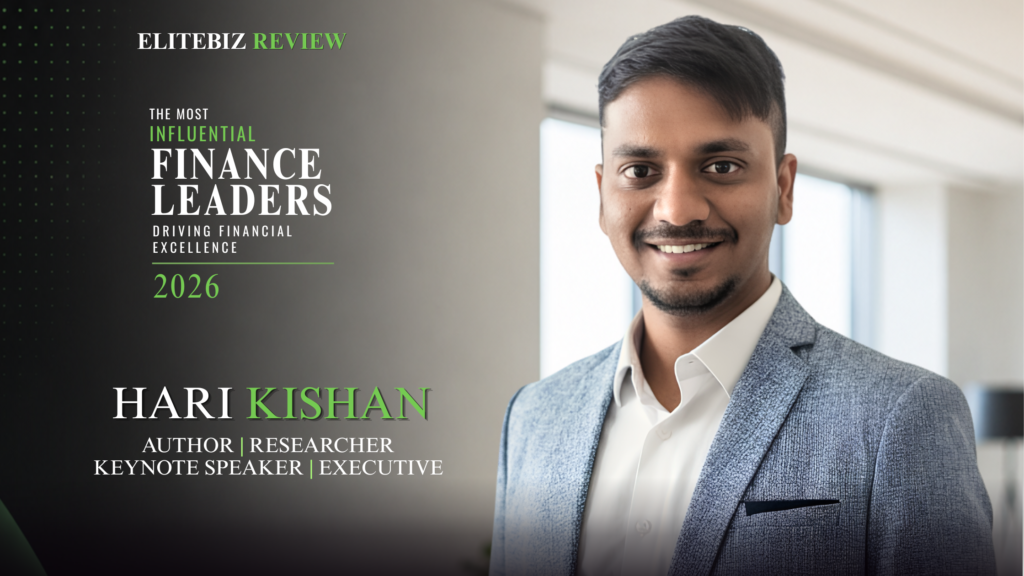
Hari Kishan, Author | Researcher | Keynote Speaker | Executive
Every technological breakthrough promises to transform industries, but few fundamentally change the relationship between organizations and the people they serve. In financial services, where every interaction depends on confidence, security, and accountability, innovation is measured by more than speed or sophistication. It is measured by trust.
For Venkata Harikishan Koppuravuri, widely known as Hari Kishan, trust has never been an outcome of technology, it has been its starting point.
Across a career spanning cloud engineering, customer experience transformation, artificial intelligence, research, authorship, and public speaking, he has built a leadership philosophy grounded in a simple belief: technology should serve people, not the other way around. While many organizations focus on what technology can do, Hari Kishan believes the more important question is what technology should do-and whom it should serve.
That perspective has shaped a career that extends well beyond executive leadership. As a technology leader, researcher, author, and keynote speaker, he operates at the intersection of enterprise execution and thought leadership. Challenges encountered in large-scale transformation programs often become subjects of deeper research and writing, while insights gained through research continually influence how he approaches business and technology decisions. Together, these experiences have created a leadership style that combines strategic thinking, technical expertise, and a strong understanding of human impact.
At the center of his work is a conviction that remains remarkably consistent: technology should make people feel more confident, not more complicated. Whether leading cloud modernization initiatives, designing AI-powered customer experiences, mentoring professionals, or contributing to industry discussions, his focus remains on building solutions that organizations can scale, teams can sustain, and customers can trust.
Where Engineering Met Empathy
Hari Kishan’s journey did not begin with ambitions of becoming a thought leader. It began with a desire to solve problems.
One of the experiences that significantly shaped his perspective came during his work in the MarTech industry, where he contributed to building a platform at a time when concepts such as Multi-Touch Attribution and Marketing Mix Modeling were still emerging. While the project focused on processing large volumes of marketing and customer data, he became increasingly interested in what that data represented beyond numbers.
Every click, campaign response, conversion, and customer interaction reflected decisions made by real people. Patterns in the data revealed changing expectations, customer preferences, and evolving business relationships. The deeper he explored these insights, the more he realized that technology was not simply helping organizations collect information, it was helping them understand people. That realization transformed the way he viewed engineering.
Software was no longer just a collection of features or technical requirements. It became a bridge between organizations and the customers they served. The quality of that bridge depended not only on performance and scalability but also on how effectively it addressed customer needs, respected privacy, and adapted to changing expectations.
The platform eventually evolved into a configuration-driven framework capable of integrating with more than thirty marketing vendors. Yet the most valuable outcome was not the technology itself. It was the lesson that meaningful innovation begins with understanding people before designing solutions. That philosophy would continue to influence every stage of his career.
Another defining chapter emerged during his work with one of the Big Four consulting firms, where he helped organizations transform customer engagement through AWS Connect and cloud-based AI solutions. Demonstrating these technologies to enterprise clients was never about showcasing technical capabilities alone. The real challenge was helping leaders understand how technology could simplify customer journeys, strengthen resilience, and create measurable business value.
Those conversations frequently moved beyond architecture diagrams and infrastructure discussions. Executives wanted to understand how emerging technologies could improve customer experiences, accelerate decision-making, and support long-term growth. The response reinforced a principle that continues to guide his work today: innovation earns its value only when it solves problems that matter.
Leadership Begins Long Before Technology
As Hari Kishan transitioned from engineering into enterprise leadership, his understanding of transformation evolved. Building reliable platforms and scalable architectures remained essential, but he recognized that technology alone rarely determines success. Most transformation initiatives do not struggle because organizations lack tools or platforms. They struggle when people lose alignment, communication breaks down, or teams become disconnected from a shared purpose. This insight became a defining element of his leadership philosophy.
He views governance as more than a collection of compliance requirements, policies, or security controls. Governance also exists within culture, in how teams communicate, collaborate, challenge assumptions, and take ownership during periods of uncertainty. While these factors rarely appear on executive dashboards, they often have a greater influence on transformation outcomes than technical metrics alone.
As a result, Hari Kishan pays close attention to indicators that many organizations overlook: curiosity, motivation, confidence, engagement, and adaptability. These qualities often provide a clearer picture of an organization’s readiness for change than project schedules or delivery statistics.
One analogy he frequently uses reflects this perspective. Building a successful transformation, he believes, is much like producing a memorable film. Every initiative begins with a purpose. Every individual contributes a unique role. Challenges create opportunities for learning, while collaboration shapes the final outcome. Customers ultimately experience only the finished result, but behind every successful transformation lies careful planning, disciplined execution, and the collective effort of many people working toward a common goal.
Technology may enable change, but people determine its success. This people-centered philosophy also shapes the way he mentors future leaders. Rather than focusing exclusively on technical expertise, he looks for qualities that support long-term growth: curiosity, resilience, adaptability, and a willingness to learn continuously.
Technical skills can be developed over time. The desire to grow and evolve must come from within. He encourages professionals to broaden their perspective beyond engineering disciplines alone. Understanding business objectives, customer behavior, communication, governance, and leadership is equally important for those seeking to create meaningful impact. The most effective leaders are often those who can connect technical knowledge with business outcomes and human needs.
For Hari Kishan, leadership is not about creating followers. It is about helping others develop the confidence and capability to become leaders themselves.
Engineering Customer Confidence
Few industries carry greater responsibility than financial services. Every technology decision influences not only operational performance but also the confidence customers place in institutions that manage their savings, investments, insurance, and financial wellbeing. Hari Kishan believes this responsibility has fundamentally reshaped the role of cloud engineering.
Cloud is no longer simply an infrastructure strategy. It has become the foundation for innovation, resilience, security, and customer experience. It enables organizations to respond more quickly to changing expectations while maintaining the reliability and trust that customers demand.
At the same time, he emphasizes that innovation without governance creates risk rather than progress. This perspective has become increasingly relevant as organizations adopt Voice AI, Agentic AI, and intelligent automation. To Hari Kishan, Voice AI represents far more than conversational technology. Every customer interaction carries unique context. Some customers seek guidance, others need reassurance, and many simply want clear answers delivered quickly and securely.
Designing effective voice experiences therefore requires more than advanced language models. It demands contextual awareness, privacy protection, empathy, and seamless collaboration between intelligent systems and human expertise.
His view of Agentic AI follows a similar principle. Autonomous systems have tremendous potential to transform enterprise operations, but intelligence alone should not determine autonomy. AI systems must understand not only what they can do, but also when human judgment should take precedence.
He often describes this approach as controlled autonomy rather than unrestricted intelligence. Organizations should empower AI to accelerate outcomes while ensuring accountability, transparency, and governance remain embedded within every decision.
For him, the next generation of enterprise success will not be defined solely by the sophistication of technology. It will be defined by how effectively organizations balance innovation with responsibility and ambition with accountability.
Where Enterprise Leadership Meets Thought Leadership
For Hari Kishan, leadership has never been confined to organizational boundaries. The same curiosity that drives him to solve enterprise challenges also inspires him to explore broader questions about the future of technology. Over the years, this curiosity has found expression through research, writing, keynote speaking, mentoring, and engagement with innovation and startup communities. Rather than viewing these pursuits as separate achievements, he sees them as natural extensions of his work as a technology leader.
Every enterprise transformation presents new lessons, and every emerging technology raises new questions. Writing and research provide an opportunity to examine those questions more deeply, challenge conventional thinking, and contribute practical insights to the broader technology community.
This philosophy is reflected in his book, The Thinking Voice, where he explores how voice technologies are evolving from simple automation tools into intelligent enterprise assets. While Voice AI is often discussed in terms of efficiency, Hari Kishan focuses on its broader potential to create intuitive, trustworthy, and context-aware customer experiences. Building such systems, he believes, requires organizations to think beyond language models and give equal importance to governance, privacy, ethics, customer intent, and effective collaboration between humans and intelligent systems.
His research papers and technical publications reflect the same balance between theory and practice. Covering topics such as cloud engineering, AI governance, enterprise modernization, customer experience, and responsible automation, his work is grounded in practical enterprise experience. For Hari Kishan, research is valuable only when it helps organizations solve real business challenges and make better decisions.
As a keynote speaker, he encourages audiences to look beyond technological capability and focus on purposeful innovation. Whether addressing industry conferences, leadership forums, or professional communities, he emphasizes that successful digital transformation depends not only on adopting emerging technologies but also on building cultures that embrace continuous learning, collaboration, and responsible innovation.
Mentoring is equally important to him. Having experienced multiple stages of technology transformation firsthand, he understands the importance of supporting the next generation of professionals. He encourages aspiring leaders to develop strategic thinking, communication skills, and business understanding alongside technical expertise. Knowledge, he believes, creates its greatest impact when it is shared.
Designing the Future Responsibly
As financial institutions continue navigating an increasingly digital future, Hari Kishan believes technology leaders must balance innovation with responsibility more carefully than ever before.
Cloud engineering is evolving from infrastructure management into a strategic capability that enables resilience, security, agility, and continuous innovation. At the same time, artificial intelligence is becoming deeply embedded across customer engagement, fraud detection, document processing, predictive analytics, and enterprise decision-making. Yet he believes the conversation around AI must move beyond capability alone.
The first wave of enterprise adoption has focused on what generative AI can accomplish. The next phase will be defined by how responsibly organizations deploy, govern, and maintain these systems throughout their lifecycle.
Disciplines such as LLMOps will become increasingly important as organizations optimize prompts, manage models, control costs, improve retrieval quality, monitor performance, and ensure reliability at scale. Success will depend not only on building powerful AI systems but on operating them responsibly and transparently.
Hari Kishan is equally optimistic about the future of Voice AI and Agentic AI. Voice interfaces will become increasingly natural, multilingual, and capable of supporting customers through more complex interactions. Agentic AI will introduce greater autonomy into enterprise operations, but autonomy must always exist within clearly defined governance frameworks.
Intelligent systems should understand the limits of their authority, recognize situations requiring human judgment, and maintain transparency in every decision they influence. Organizations that master this balance, he believes, will build stronger customer relationships than those focused solely on technological advancement.
Looking further ahead, he also sees significant potential in GPU-accelerated computing and quantum technologies. Although still evolving, these innovations could reshape financial modeling, optimization, risk analysis, and computational efficiency. Preparing for these shifts today will help organizations remain resilient as tomorrow’s technologies become commercial realities. Despite these advances, Hari Kishan remains convinced that technology itself will never become the defining competitive advantage. Trust will.
The Human Side of Innovation
Throughout his career, Hari Kishan has remained guided by values that have remained constant despite the rapid evolution of technology.
Curiosity drives him to explore new ideas and challenge assumptions. Empathy reminds him that behind every dashboard, customer interaction, and enterprise transformation are people whose experiences matter. Ownership encourages him to think beyond immediate deliverables and focus on creating long-term value for organizations, customers, and colleagues.
Perhaps most importantly, he believes leadership begins with humility. No technology leader possesses every answer, particularly in fields evolving as rapidly as artificial intelligence and cloud computing. Remaining open to new perspectives, learning continuously, and encouraging constructive debate are qualities that strengthen both individuals and organizations. His advice to aspiring professionals reflects these principles.
Develop technical depth, but do not allow expertise to limit your perspective. Understand how businesses operate, learn to communicate with clarity, and invest in understanding customers as deeply as you understand technology. Share knowledge through research, writing, speaking, and mentoring, because influence is built through contribution rather than position. Above all, remain curious. The technologies shaping today’s conversations will continue to evolve, but the ability to learn, adapt, and lead with integrity will remain timeless.
Looking Ahead with Purpose
As industries continue redefining what technology can achieve, Hari Kishan believes the greatest investment professionals can make is not in mastering a single platform or framework but in developing the ability to learn continuously.
Cloud platforms will evolve, AI models will become more capable, and entirely new disciplines will emerge. What will endure are qualities such as curiosity, adaptability, ethical leadership, and the ability to connect technology with meaningful business outcomes.
Organizations face a similar challenge. As AI becomes increasingly autonomous, competitive advantage will belong not simply to those who adopt advanced technologies first, but to those who govern them responsibly, earn customer trust, and build innovation on a foundation of accountability.
Hari Kishan’s own journey, from enterprise technology leadership to research, authorship, and keynote speaking, reflects this belief. Across every role, his purpose has remained consistent: helping organizations build technology that is innovative without losing sight of humanity, scalable without sacrificing trust, and intelligent enough to solve complex problems while remaining accountable to the people it serves.
In an era defined by rapid technological change, his perspective offers an enduring reminder. The future will undoubtedly be shaped by more capable AI, more powerful cloud platforms, and increasingly autonomous systems. But lasting progress will belong to organizations that remember a simple truth: the most valuable innovations are not those that merely think faster, but those that strengthen trust, create meaningful relationships, and improve people’s lives. For Hari Kishan, that is where meaningful innovation truly begins and where lasting leadership is defined.