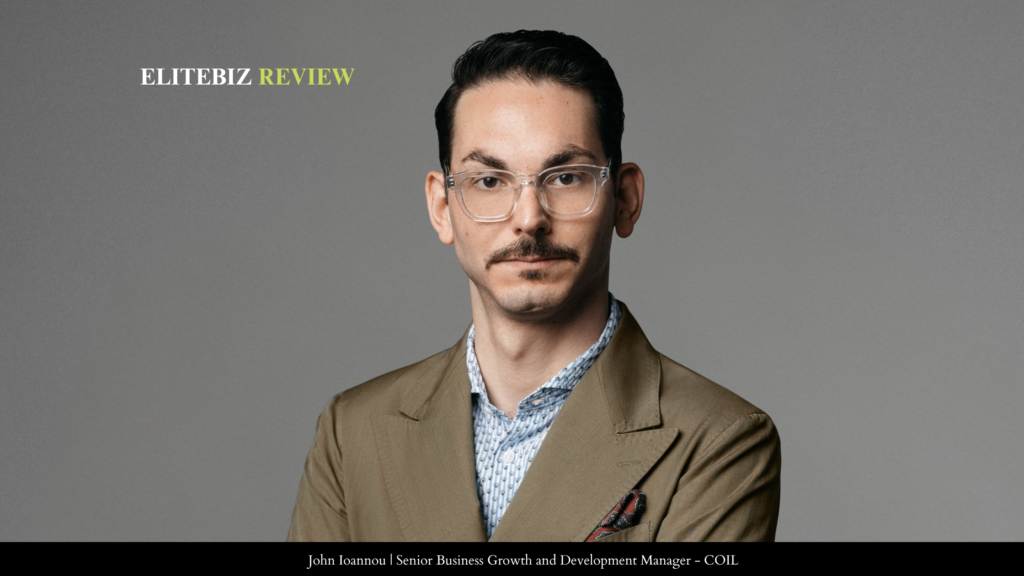
The electric mobility conversation often begins with vehicles. New EV models, battery advancements, autonomous transportation technologies, and sustainability commitments dominate industry discussions and media headlines. Yet behind every successful electrification initiative lies a far more complex story, one built on infrastructure, energy planning, utility coordination, technology integration, and countless decisions that determine whether a project succeeds long after the ribbon-cutting ceremony.
For John Ioannou, Senior Business Growth and Development Manager at COIL, this is where the most meaningful work takes place. Throughout his career, he has developed a perspective that extends beyond charging stations and vehicle deployments. He views electrification as an interconnected ecosystem where transportation, energy, infrastructure, and people must work together seamlessly to create lasting impact.
It was 2021 when John was working for a major American car rental company that placed the largest purchase order for electric vehicles in the history of the industry. A few months later, as a branch manager in Manhattan, he was among the first to introduce EVs to the local market, and came face to face with a harsh reality: the complete absence of charging infrastructure to support them. That firsthand experience naturally steered his focus toward the electrification movement itself, and COIL with the right team and the right mission, was the place to execute on that vision.
Working at the intersection of business growth and sustainable mobility has given John a front-row seat to one of the most significant industrial transformations of our time. As organizations across North America continue exploring electrification strategies, he has become increasingly focused on helping customers navigate the complexities that exist behind the scenes.
His role is not simply about supporting projects; it is about helping organizations build foundations capable of supporting long-term sustainability, operational efficiency, and future growth.
That perspective has become particularly valuable as the EV industry moves beyond early adoption and enters a period where scalability, resilience, and intelligent infrastructure are becoming just as important as innovation itself.
A Career Shaped by Growth, Adaptability, and Execution
John’s journey in business growth and development has unfolded during a period of rapid technological advancement and market transformation. Over the years, he has worked across evolving industries where success often depended on understanding not only emerging opportunities but also the practical realities of implementation.
Those experiences have significantly influenced the way he approaches leadership today. Rather than viewing growth as simply acquiring new customers or expanding market presence, he sees growth as helping organizations solve meaningful challenges while creating sustainable value over time.
His work at COIL has reinforced that philosophy. Supporting charging infrastructure initiatives across school districts, municipalities, police stations, fleet operators, multifamily communities, commercial properties, public charging networks, and logistics organizations has exposed him to a diverse range of customer needs and operational realities. Each project presents unique requirements, timelines, stakeholders, and objectives.
John is also actively building strategic partnerships and expanding COIL iQ, COIL’s proprietary AI-powered platform for residential electric vehicle charging installations.
The platform connects utilities, contractors, and customers through a single system that streamlines estimating, project tracking, invoicing, and project delivery.
One lesson has remained consistent throughout these experiences: successful electrification is never as simple as installing charging equipment. Every project requires extensive planning, utility engagement, engineering expertise, permitting coordination, construction management, commissioning, and long-term operational support. What may appear straightforward from the outside often involves months of collaboration among multiple stakeholders working toward a shared objective.
This understanding has fundamentally shaped John’s leadership perspective. In the EV sector, growth is not measured solely by awarded projects, completed installations or project volume. It is measured by helping customers make informed decisions, reducing implementation risks, and creating infrastructure that can support future expansion as transportation and energy systems continue to evolve.
Why the Industry Must Think Beyond Charging
As electric mobility accelerates globally, John believes one of the most important shifts leaders must embrace is moving beyond a charger-first mindset and adopting a broader infrastructure-first perspective.
During the early stages of EV adoption, much of the conversation understandably centered around charger availability and up time. However, as electrification expands into larger fleets, school transportation, logistics operations, municipalities, and commercial environments, the industry is encountering more sophisticated challenges.
The question is no longer simply where chargers should be installed. Increasingly, organizations must consider how those chargers will be powered, how energy demand will be managed, how infrastructure can remain resilient during disruptions, and how systems can scale as adoption increases.
This shift becomes especially important as electrification extends beyond passenger vehicles. School buses, delivery fleets, heavy-duty transportation, municipal vehicles, and commercial operations each present unique energy requirements and operating schedules. Supporting these applications requires a deeper understanding of grid readiness, size (kW) of equipment, demand charges, load management, energy storage, and long-term infrastructure planning.
For John, the future belongs to organizations that connect transportation and energy through intelligent vehicle-grid integration platforms as part of one cohesive strategy. By optimizing the charging and discharging of electric vehicles, battery storage, solar generation, and other distributed energy resources, these systems can improve energy efficiency, strengthen fleet operations, and transform commercial and residential assets into flexible energy networks that benefit the grid and create value for customers. Realizing this potential will require supportive policies, expanded utility-led virtual power plant programs, and clearer pathways for participation in energy markets and grid services.
Balancing Commercial Success with Sustainability
One of the defining aspects of John’s professional approach is his belief that sustainability and commercial success should never be viewed as competing priorities.
Throughout his career, he has consistently found that the most successful projects are those where environmental objectives and business goals work together. Sustainable infrastructure must deliver measurable return on investment if organizations are going to continue investing in it. Likewise, long-term business growth increasingly depends on responsible energy planning and sustainable operational strategies.
This balanced perspective becomes particularly important when working with organizations facing rising energy costs, evolving regulations, and increasing pressure to modernize their operations.
Fleet operators, municipalities, school districts, healthcare systems, airports, and commercial organizations are all seeking solutions that deliver real cost savings — replacing gas and diesel engines with electric alternatives, swapping diesel generators for battery energy storage systems paired with solar to generate and store clean energy on-site, implementing smarter energy management both behind and in front of the meter, and building infrastructure that reduces long-term operational expenses while maintaining reliability and financial practicality.
John believes the answer lies in long-term thinking. Rather than focusing solely on immediate infrastructure needs, organizations should consider how charging infrastructure, battery energy storage, solar generation, intelligent load management, and future technologies can work together as part of a broader strategy and within a well-orchestrated synergy of interconnected systems.
By approaching electrification through this lens, customers can create systems that not only reduce emissions but also improve resilience, optimize energy usage, and provide long-term economic benefits.
Lessons Learned from Complex Challenges
While the EV industry offers tremendous opportunities, it also presents significant challenges. Throughout his professional journey, John has learned that some of the most valuable lessons emerge from navigating complexity.
One of the most common challenges in large-scale electrification projects is stakeholder alignment. Unlike traditional infrastructure initiatives, EV deployments often involve utilities, engineers, contractors, technology providers, fleet operators, permitting authorities, public agencies, and asset owners. Each group has different priorities, timelines, and requests.
Successfully managing these relationships requires patience, communication, and a willingness to understand perspectives beyond one’s own area of expertise. John has learned that technical solutions alone rarely determine project outcomes. The ability to build trust, foster collaboration, and maintain alignment among stakeholders often plays an equally important role.
The rapidly evolving nature of the industry presents another challenge. Technologies continue advancing, incentive programs change, customer expectations evolve, and energy requirements for each client become increasingly sophisticated. Rather than viewing these changes as obstacles, John sees them as opportunities to learn and adapt.
His experience has reinforced the importance of remaining curious, staying informed, and approaching challenges with a long-term mindset. In an industry moving as quickly as sustainable mobility, adaptability is not simply an advantage, it is a necessity.
Milestones That Reflect a Larger Transformation
When reflecting on achievements throughout his career, John is most proud of projects that create meaningful impact beyond the infrastructure itself.
Several school transportation initiatives stand out as particularly significant examples. Programs involving Zūm and Branford School district have demonstrated how electrification can transform not only transportation operations but also energy management strategies.
Similarly, Zūm’s deployment with San Francisco Unified School District represents an important milestone in the evolution of electric school transportation, bringing together electric vehicles, charging infrastructure, routing intelligence, and bidirectional energy capabilities within a single ecosystem.
These projects hold special significance because they illustrate what electrification can become when viewed through a broader strategic lens. Electric school buses are no longer simply transportation assets. Through Vehicle-to-Grid capabilities and intelligent energy integration, they can contribute to resilience, grid support, and long-term sustainability objectives within their communities.
John is also proud of COIL’s work with Nuvve across multiple school districts. Through these collaborations, the company has helped deploy bidirectional charging infrastructure that demonstrates the practical potential of vehicle-to-grid and vehicle-to-building technology in real-world environments. At Porterville Unified School District, for example, COIL and Nuvve are deploying a microgrid application at the district’s central kitchen, where an old freezer building was identified as critical infrastructure to be backed up with 3 V2G chargers and a battery energy storage unit, with project completion expected later this year.
At Baldwin Park Unified School District, a similar approach is underway, with the district’s IT building identified as the critical infrastructure to be supported by the solution. These projects illustrate how school districts are using electrification not just for transportation but to build resilience around the facilities their communities depend on most.
Another milestone that remains particularly meaningful is the installation of ChargePoint 280 chargers at Hermann Services’ Distribution Center in New Jersey. This project is the product of an intense collaboration between EV Ready Energy and COIL, working together to deliver a white-glove experience for the end user. For John, it symbolizes not only the willingness of established organizations to embrace change and prepare proactively for the future of freight transportation, but also what becomes possible when the right partners align around a shared commitment to execution and client service.
Recognition from industry sources such as Ohm Analytics further reinforces the significance of these efforts. While external recognition is appreciated, John believes the true measure of success lies in the lasting value these projects create for customers and communities.
The Power of Collaboration and Teamwork
Throughout his career, collaboration has played a central role in John’s professional success. Electrification is inherently an ecosystem effort, and meaningful progress depends on the contributions of many organizations and individuals working restlessly toward shared goals.
At COIL, this collaborative mindset is deeply embedded within the company culture. Under the leadership of founder Bobby Penn, the organization has built a reputation for combining technical expertise with a strong commitment to project execution, customer success and teamwork.
John is quick to acknowledge that no single person drives the company’s achievements. Success comes from individuals across the organization who contribute their expertise, problem-solving abilities, and dedication to every project. Team members such as Michael Boerste, Guido Iammatteo, Kim Gongora, and Larissa Grant each bring unique strengths that help support COIL’s continued growth and execution capabilities.
For John, strong teams are built on trust, communication, accountability, and mutual respect. While technology continues transforming industries at unprecedented speed, he believes the human element remains irreplaceable. Meaningful relationships, collaborative problem-solving, and shared commitment will continue defining successful organizations regardless of how rapidly technology evolves.
The Future of Mobility and Intelligent Energy Systems
Looking ahead, John sees tremendous potential in technologies that connect transportation and energy more intelligently.
Vehicle-to-Everything technology, often referred to as V2X, represents one of the most exciting developments within the industry. Rather than functioning solely as transportation assets classes, electric vehicles are increasingly positioned to become active participants within broader energy ecosystems.
At the residential level, Vehicle-to-Home applications can help homeowners improve resilience and energy flexibility. When integrated with solar generation and battery storage, EVs can contribute to a more dynamic and efficient energy environment.
At the commercial level, Vehicle-to-Building and microgrid solutions offer opportunities for organizations to better manage energy costs, reduce peak demand, and improve operational resilience. Schools, healthcare facilities, municipalities, airports, and fleet operators all stand to benefit from these emerging capabilities.
For John, the true promise of electrification extends beyond cleaner transportation. It lies in the ability to create intelligent systems where vehicles, buildings, energy storage, renewable generation, and utility infrastructure work together as part of a connected ecosystem.
Building What Comes Next
As the sustainable mobility industry continues advancing, John remains focused on the principles that have guided his career from the beginning: stay curious, remain adaptable, prioritize collaboration, and never lose sight of execution.
He often encourages emerging professionals to develop a broad understanding of the industry rather than concentrating on a single area. The future of mobility involves transportation, energy, construction, software, policy, customer experience, finance, and infrastructure. Leaders who understand how these elements connect will be best positioned to create meaningful impact.
More importantly, John believes lasting success comes from turning ambitious ideas into practical outcomes. Vision creates direction, but execution creates measurable results.
Through his work at COIL, he continues helping organizations navigate one of the most significant transitions in modern transportation. The projects may involve charging infrastructure, fleet electrification, microgrids, or emerging V2X technologies, spanning electric vehicles to electric buses, white fleets to heavy-duty trucks like the Tesla Semi, and ground transportation to eVTOLs and electric aircrafts, the underlying mission remains the same: building the systems that will support a cleaner, more resilient, and more sustainable future.
In many ways, the electric mobility revolution is still in its early chapters. Yet the foundations being built today will determine how successfully that future unfolds.
By helping connect infrastructure, energy strategy, technology, and people, John Ioannou is contributing to a transformation that extends far beyond vehicles, one that has the potential to reshape how communities move, consume energy, and prepare for the decades ahead.