
Technology has always moved quickly, but the modern telecommunications landscape is evolving at a pace that is reshaping how industries operate, how decisions are made, and how organizations think about the future itself. Networks are no longer just infrastructure sitting quietly in the background. They have become the invisible framework powering operational intelligence, real time coordination, predictive decision making, and connected ecosystems across industries worldwide.
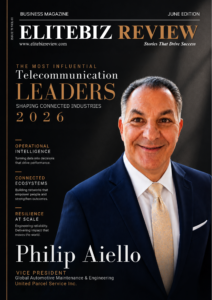
For Philip Aiello, Vice President, Global Automotive Maintenance & Engineering at United Parcel Service Inc., telecommunications is not simply about connectivity. It is about enabling reliability at scale, creating operational resilience, and turning information into measurable outcomes that improve safety, efficiency, and performance across highly distributed global environments.
Over the course of his career, Philip has worked at the intersection of operations, engineering, data, and emerging technology. His perspective has been shaped not by theory alone, but by the realities of running complex systems where uptime matters, where operational continuity cannot fail, and where decisions made in seconds can influence large scale outcomes across networks of vehicles, facilities, infrastructure, and people.
What distinguishes Philip’s leadership approach is the balance he brings between innovation and discipline. At a time when organizations are flooded with new technologies, bold claims, and constant disruption, he believes leadership requires something increasingly rare: the ability to stay objective while remaining open to change. His philosophy centers on structured evaluation, operational practicality, and responsible implementation rather than chasing trends for the sake of appearance.
That mindset has become especially important in 2026, where telecommunications is no longer viewed as an isolated industry. It now influences transportation, logistics, healthcare, manufacturing, infrastructure, mobility, automation, and global commerce. Connectivity has evolved into the nervous system of modern operations, enabling organizations to move from reactive decision making toward predictive and continuously optimized ecosystems.
For Philip, the future belongs to leaders who can translate technological capability into real world impact while never losing sight of the people operating within those systems. Behind every network, every connected asset, and every intelligent platform are individuals adapting to new ways of working. Leadership, in his view, is ultimately about helping organizations evolve responsibly while building trust along the way.
Leadership in an Era Defined by Constant Technological Acceleration
One of the defining challenges facing modern leaders is navigating an environment where technology evolves faster than traditional decision making models were designed to handle. In telecommunications particularly, the pressure to innovate is relentless. Every year introduces new platforms, new architectures, new forms of automation, and new promises of transformation.
Philip believes influential leadership in this environment depends on the ability to separate genuine long term value from short term excitement. Experience can be an advantage because it helps leaders recognize operational patterns and understand what truly scales in production environments. At the same time, experience can also create bias if leaders become too attached to past assumptions. That is why neutrality, according to Philip, must be treated as a discipline rather than a personality trait.
Throughout his career, he has developed a structured framework for evaluating emerging technologies without becoming overly influenced by hype cycles or market narratives. The first step always involves defining the actual operational problem. Before examining any tool or platform, the focus must remain on understanding the business objective itself. Is the organization trying to improve safety, reduce downtime, increase reliability, enhance customer experience, or accelerate decision making? Without clarity around the problem, even impressive technologies can become expensive distractions.
The second layer involves understanding the maturity of the technology itself. Some innovations are still experimental, while others are entering scalable deployment phases. Knowing where a solution sits within its lifecycle helps organizations determine appropriate risk exposure and implementation strategy.
Finally comes validation. Philip strongly believes in what he describes as a “trust but verify” philosophy. Pilots and testing environments must evaluate not only technical functionality, but also scalability, interoperability, cybersecurity resilience, governance alignment, and measurable operational return.
What makes this approach particularly effective is that it encourages organizations to innovate responsibly rather than emotionally. It creates space for curiosity while protecting long term operational stability.
Just as importantly, Philip fosters environments where dissenting perspectives are encouraged rather than discouraged. He believes strong leaders do not eliminate bias entirely. Instead, they create processes and cultures that prevent personal assumptions from dominating critical decisions.
Telecommunications as the Foundation of Operational Intelligence
The telecommunications sector today extends far beyond traditional communication systems. It has become deeply integrated into the operational architecture of modern industry. From connected vehicles and intelligent facilities to predictive analytics and autonomous systems, connectivity increasingly determines how effectively organizations can operate in real time. Philip sees telecommunications as one of the primary enablers of operational agility in the coming decade.
Historically, many industries relied heavily on lagging indicators and retrospective analysis. Problems were identified after they occurred, and organizations reacted accordingly. Today, continuous connectivity is transforming that model entirely. Real time data streams allow businesses to anticipate disruptions, optimize workflows, monitor assets proactively, and respond to emerging issues before they escalate. This evolution is fundamentally changing how industries think about decision making.
Connected ecosystems now allow organizations to integrate people, processes, infrastructure, and assets into synchronized operational networks. Vehicles, facilities, devices, maintenance systems, and digital platforms continuously exchange information, creating feedback loops that support faster and more informed decisions. For Philip, the real value of telecommunications lies not simply in generating more information, but in improving the quality and speed of decision making itself.
He believes the organizations that will lead in the future are not necessarily those with the largest volumes of data. Rather, success will belong to organizations capable of transforming data into actionable intelligence while maintaining governance, trust, and operational discipline.
This shift is also creating entirely new business models. Data has become a strategic asset capable of driving productivity improvements, enhancing customer experiences, and enabling predictive operational capabilities that were once impossible. However, Philip emphasizes that with greater connectivity also comes greater responsibility. Privacy, cybersecurity, governance, and ethical implementation must remain central considerations rather than afterthoughts. In highly connected environments, trust becomes just as important as technological capability.
Building Innovation Through Optimistic Discipline
Innovation is often portrayed as disruption for its own sake, but Philip approaches transformation differently. He believes sustainable innovation succeeds when organizations treat it as a repeatable capability rather than a one time initiative. His leadership philosophy centers on what he calls optimistic discipline: remaining excited about technological possibilities while maintaining rigorous operational standards.
In practice, this means every innovation effort must connect clearly to meaningful business outcomes. Technology implementation should improve safety, reliability, uptime, customer experience, operational resilience, or workforce effectiveness. Without that connection, even advanced systems risk becoming isolated tools with limited long term value.
Philip also stresses the importance of integration. In modern enterprises, isolated technological wins rarely create sustainable transformation. Solutions must fit within broader operational ecosystems, governance frameworks, and existing workflows. Systems that cannot integrate effectively often become fragmented assets that create complexity rather than efficiency. Equally important is managing organizational change intentionally.
One of the most overlooked realities of digital transformation is that people experience change differently than systems do. While technology can scale quickly, human adaptation takes time. Training, communication, stakeholder alignment, and frontline engagement are essential components of successful implementation.
Philip believes organizations often underestimate the operational fatigue created by constant transformation initiatives. That is why he focuses heavily on creating sustainable change models that allow teams to evolve gradually while maintaining operational stability. For him, innovation is not a department. It is a management philosophy embedded into everyday decision making and continuous improvement.
The Telecommunications Trends Reshaping Global Industries
As industries continue becoming more connected, several telecommunications trends are emerging that Philip believes will fundamentally reshape operational ecosystems over the next few years. One of the most significant developments is the rise of edge to cloud architectures. Organizations increasingly require faster processing capabilities closer to operational environments while still leveraging cloud infrastructure for analytics, orchestration, and enterprise wide intelligence. This combination improves responsiveness while supporting scalability and resilience.
Cybersecurity is another area becoming inseparable from operational architecture. As connected ecosystems expand, attack surfaces naturally grow larger. Philip believes security can no longer function as an isolated compliance exercise added later in the process. It must be embedded directly into procurement decisions, infrastructure design, governance standards, and operational workflows from the beginning.
Network resilience is also becoming a defining priority for global operations. Organizations now recognize that dependable connectivity is not optional infrastructure. It is mission critical. As a result, businesses are increasingly investing in redundancy models, failover systems, multi path connectivity strategies, and predictive monitoring tools designed to identify degradation before disruptions occur.
At the same time, data governance is emerging as one of the most important differentiators in connected ecosystems. Collecting information is no longer the challenge. The real challenge involves determining what information should be retained, who can access it, how it should be governed, and how privacy obligations can be managed responsibly across regions and industries. Philip believes organizations that establish adaptable governance frameworks early will ultimately move faster and operate with greater confidence than competitors struggling to retrofit compliance later.
From Asset Management to Ecosystem Leadership
The evolution of mobility, IoT, and real time connectivity has significantly changed how Philip views leadership itself. Traditional operational models focused heavily on managing individual assets independently. Today, connected technologies have shifted the focus toward managing ecosystems where vehicles, facilities, infrastructure, devices, and operational teams continuously interact through shared information environments. This shift requires a very different leadership mindset.
Real time connectivity creates opportunities for faster decisions, but it also increases the importance of data quality and contextual accuracy. Faster information is only valuable if it is reliable. Poor quality data processed rapidly simply creates confusion at greater speed. That reality has reinforced Philip’s emphasis on validation, governance, and operational discipline.
It has also strengthened his belief that future ready operations must remain human centered. Connectivity directly influences frontline work environments, maintenance processes, operational workflows, and employee decision making. Leaders therefore have a responsibility to ensure technological systems reduce friction rather than create additional complexity for operational teams.
Philip believes the strongest organizations involve frontline operators early in implementation discussions, explain the purpose behind technological changes clearly, and create environments where employees feel part of transformation efforts rather than subjects of them. This approach builds trust while accelerating adoption and operational alignment.
Why Cross Functional Collaboration Determines Long Term Success
In highly connected industries, no single department can drive transformation independently. Telecommunications, infrastructure, operations, cybersecurity, engineering, leadership, and governance functions must operate in close coordination to create sustainable outcomes.
Philip sees collaboration as one of the defining requirements for modern operational success.
Technology teams may design solutions, but infrastructure teams ensure reliability and performance. Leadership teams establish strategic direction, governance standards, funding priorities, and operational accountability. Without alignment between these groups, even well designed initiatives often fail. Strong collaboration creates operational multipliers. It improves speed, reduces cost, increases resilience, and strengthens long term scalability.
Philip emphasizes the importance of shared operating rhythms where teams continuously exchange feedback, align priorities, and maintain visibility into evolving operational requirements. Organizations that treat telecommunications as strategic infrastructure rather than isolated technical capability are far better positioned to adapt to future challenges.
Creating Cultures That Embrace Learning and Adaptability
For Philip, sustainable innovation begins with culture. Organizations operating in highly connected and rapidly evolving environments need teams that are comfortable learning continuously, adapting quickly, and challenging assumptions constructively. Building that kind of culture requires both psychological safety and operational clarity.
Philip encourages environments where experimentation is supported within clearly defined guardrails. Failure, when approached responsibly, becomes a learning mechanism rather than something to hide. He also places significant value on candor. Team members are encouraged to communicate concerns openly, challenge assumptions early, and prioritize honesty over hierarchy. In complex operational environments, transparency often prevents costly surprises later.
Another important aspect of his leadership style is iterative learning. Few technologies arrive fully optimized on day one. Most improve through deployment cycles involving measurement, refinement, operational feedback, and continuous improvement. Organizations that normalize this process build far greater adaptability over time.
Most importantly, Philip connects innovation directly to mission and purpose. Employees become far more engaged when they understand how their work improves safety, reliability, customer experience, or operational effectiveness. Innovation becomes meaningful when it is tied to tangible outcomes that people can see and influence directly.
The Future of Telecommunications and Human Centered Innovation
Looking ahead, several emerging innovations particularly excite Philip because of their potential to improve both operational performance and everyday quality of life.
One area involves biometrics and wearable technologies integrated with artificial intelligence. When implemented responsibly, these systems could significantly enhance health monitoring, preventive care, workforce safety, and overall well being. Real time health indicators combined with intelligent analytics may allow individuals and organizations to make better proactive decisions while improving workplace safety environments.
Another major area is autonomy within machines, vehicles, and robotics systems. Philip believes advanced autonomy has the potential to reshape productivity, operational consistency, and safety across industries. As artificial intelligence capabilities continue maturing, autonomous systems will likely become increasingly integrated into operational ecosystems worldwide. However, he consistently returns to one critical point: the impact of technology depends entirely on how leadership chooses to implement it.
Innovation without trust, governance, and ethical responsibility ultimately creates instability rather than progress. Long term success requires balancing technological ambition with operational accountability and human consideration.
Advice for the Next Generation of Telecommunications Leaders
For aspiring professionals entering telecommunications and connectivity driven industries, Philip emphasizes the importance of building both technical depth and systems level thinking.
He encourages future leaders to become genuine subject matter experts who understand how networks, cloud systems, edge computing, cybersecurity, governance, and operational ecosystems connect together. Influence, he believes, comes from competence rather than titles alone.
At the same time, he advises professionals to resist becoming overly attached to hype cycles or simplistic narratives around emerging technologies. Strong leaders evaluate innovation objectively, understand technological lifecycles, and make decisions based on timing, scalability, operational value, and long term sustainability.
Most importantly, Philip stresses the importance of protecting trust. Privacy, governance, cybersecurity, and ethical responsibility should never be viewed as obstacles to innovation. They are the foundations that allow innovation to scale sustainably over time.
As telecommunications continues shaping the future of global industries, leaders like Philip Aiello are demonstrating that the most meaningful transformation happens when connectivity is combined with operational intelligence, disciplined leadership, and a deep understanding of the people working within these evolving systems.
Because ultimately, the future of telecommunications will not be defined solely by faster networks or more advanced technologies. It will be defined by how effectively organizations use connectivity to create safer, smarter, more resilient, and more human centered operations for the world ahead.