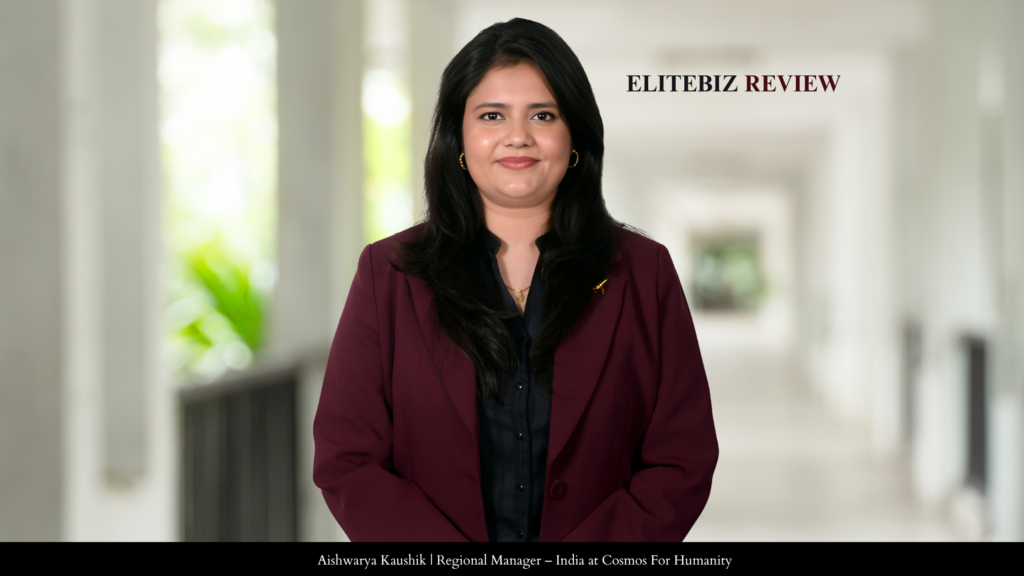
Some careers are built through calculated steps. Others are shaped by curiosity so profound that it quietly becomes purpose. Aishwarya Kaushik’s journey belongs to the latter.
Long before aerospace, sustainability, and global governance became part of her professional vocabulary, space represented wonder. It was mystery, ambition, and possibility stretched across an infinite sky. As a child growing up in India, she would spend hours looking upward, captivated by the unknown and inspired by the thought that beyond what the eye could see lay an entire universe waiting to be understood. That fascination never faded. It evolved.
Today, as Regional Manager – India at Cosmos For Humanity, Aishwarya stands at the crossroads of innovation, sustainability, and global collaboration in one of the world’s most rapidly transforming industries. Her work extends beyond advocacy and representation. She is helping shape critical conversations around space situational awareness, sustainability, inclusive governance, and the future of human participation in space. In an era where commercial missions are accelerating, orbital congestion is becoming a pressing concern, and global cooperation has never been more vital, Aishwarya represents a new generation of leaders redefining what it means to contribute to the aerospace ecosystem.
Her story is not one of a traditional aerospace path. It is the story of a multidimensional professional whose expertise spans technology, operations, research, communications, and policy. It is also the story of someone who believes that the future of space will not simply be defined by how far humanity can go, but by how responsibly, inclusively, and collaboratively it chooses to get there.
A Childhood Dream Written in the Stars
For Aishwarya, the beginning of this journey can be traced back to childhood, when space was not merely an interest but an emotional connection. Growing up in India, she found inspiration in two iconic figures whose achievements transformed her fascination into ambition.
The first was Rakesh Sharma, India’s first astronaut, whose historic mission aboard Soyuz T-11 in 1984 became one of the country’s defining milestones in space exploration years before Aishwarya was born. Yet his journey continued to inspire generations of young Indians who grew up hearing about the mission and what it represented. For Aishwarya, what left the deepest impression was not only the achievement itself, but Sharma’s now-iconic response when asked how India looked from space: “Saare Jahan Se Achha.” In those words, she saw more than patriotism. She saw how space exploration could connect deeply with identity, perspective, and human emotion.
Then came Kalpana Chawla, whose story resonated with her on a profoundly personal level. As the first woman of Indian origin in space, Kalpana represented possibility without boundaries. She broke barriers geographically, culturally, and socially. Aishwarya still remembers having a poster of Kalpana Chawla in her room, a daily reminder that dreams are only distant until someone proves they are achievable.
These pioneers did more than inspire admiration. They created belief. They made space feel real, attainable, and deeply meaningful. That belief became the foundation of a future she had not yet fully imagined.
Entering the Global Space Community
Aishwarya’s formal entry into the global space ecosystem came through the Space Generation Advisory Council (SGAC), a pivotal turning point in her professional journey. Through SGAC, she gained access to a global network of emerging professionals, researchers, policymakers, and thought leaders united by a shared mission to shape the future of space. It was here that her curiosity transformed into contribution.
She began actively participating in research initiatives, policy discussions, and international forums, engaging in meaningful dialogue around some of the industry’s most pressing challenges. One of the most defining moments during this chapter was attending the United Nations Committee on the Peaceful Uses of Outer Space Legal Subcommittee in Vienna as an SGAC delegate. Until then, her relationship with space had largely been driven by passion, research, and aspiration. UNCOPOUS changed that.
Being physically present in a room where global space policy was being debated and shaped was transformative. Listening to delegates from around the world discuss issues such as space traffic management, sustainability, and equitable long-term access to outer space shifted her perspective entirely. For the first time, she saw space not only as a frontier for exploration but as a shared global domain governed by complex legal, political, and ethical realities. It was the moment where interest became responsibility.
Representing a global youth organization in those discussions also gave her a profound sense of purpose. She was not just observing the future of space being shaped. She was contributing to it. That experience reinforced her commitment to sustainability, governance, and international cooperation-areas that continue to define her work today.
Creating Impact Through Cosmos For Humanity
Today, Aishwarya serves as Regional Manager – India at Cosmos For Humanity, a role that represents the convergence of her passion, expertise, and mission. At Cosmos For Humanity, she focuses on promoting space sustainability, fostering regional engagement, and building strategic partnerships aligned with the organization’s long-term vision. Her work spans advocacy, communications, and representation across influential global platforms.
She has represented the organization at the Global Space Exploration Conference (GLEX), the Dubai Airshow, and other major forums, speaking on critical issues such as space debris mitigation, circular space economy, inclusive governance, and space situational awareness. These are not abstract conversations. They are urgent and increasingly critical as the orbital environment becomes more congested, contested, and competitive.
Aishwarya is particularly passionate about space situational awareness and sustainability. She understands that preserving the orbital environment is no longer optional. It is essential. Her work includes supporting initiatives like the UpSat Cycle program and contributing to discussions that advocate responsible practices, coordinated action, and resilient ecosystems.
In many ways, her current role is an extension of the same childhood curiosity that once drew her to the stars. Only now, she is not just dreaming about space. She is helping protect its future.
The Power of Research, Storytelling, and Knowledge Exchange
Aishwarya believes innovation does not thrive in isolation. It thrives through communication. Her work in communications and knowledge sharing has shown her that storytelling is one of the most powerful tools in advancing aerospace innovation.
During her MBA research, she focused on understanding the evolving dynamics of the aerospace industry. This process involved engaging with a diverse range of stakeholders-from policymakers to industry professionals.
She interviewed professionals from leading aerospace organizations such as Airbus and Boeing, gaining firsthand insights into the challenges and opportunities shaping the future of aerospace. These conversations taught her an important lesson: data and research alone do not drive action. Stories do.
The ability to translate complex insights into compelling narratives is what influences decisions, sparks collaboration, and inspires innovation. This became even more evident when she co-led research presented at the International Astronautical Congress (IAC). Each conversation during that research brought unique perspectives on human spaceflight, astronaut selection, and the role of private players in exploration.
Her role was to synthesize these insights into a cohesive narrative that could contribute meaningfully to global conversations. Presenting at IAC reinforced the power of storytelling as a vehicle for knowledge exchange. Likewise, as a
panelist at the Dubai Airshow, she witnessed how effective communication can simplify complex topics such as space sustainability and situational awareness, making them more accessible and actionable. To Aishwarya, storytelling humanizes innovation. It makes space relatable. And in doing so, it drives progress.
Emerging Professionals Are Redefining the Industry
Aishwarya sees a profound transformation underway in the aerospace and space sector. Emerging professionals are not simply entering the industry. They are redefining it. For decades, space was viewed as a highly specialized field dominated by aerospace engineers, scientists, and government agencies. Today, that reality is changing rapidly. The modern space ecosystem is becoming deeply interdisciplinary. Professionals from artificial intelligence, business, law, policy, cybersecurity, manufacturing, and data science are playing increasingly important roles.
Aishwarya points to AI-driven satellite analytics, predictive modeling, and space situational awareness as examples of how new skill sets are reshaping the industry. At the same time, commercialization and policy reforms are democratizing access to the space economy. In India particularly, she sees remarkable momentum. The Indian DefSpace Symposium 2026 highlighted the integration of defence, startups, policymakers, industry leaders, and innovators into a single collaborative ecosystem. Initiatives like Mission DefSpace are opening innovation challenges to startups and young entrepreneurs. These shifts are empowering the next generation not just to join the industry, but to lead it. In Aishwarya’s words, they are not building careers. They are building ecosystems.
Democratizing Access to Space
Among the developments shaping the future of exploration, Aishwarya is particularly excited by the rise of space tourism and suborbital flight. For decades, space was accessible only to a select few. Today, private individuals from diverse nationalities, professions, and backgrounds are entering space through companies such as Blue Origin, Virgin Galactic, and SpaceX. This shift is transforming the meaning of access.
Missions like Virgin Galactic’s Galactic 02, Inspiration4, and dearMoon have broadened the purpose of spaceflight to include philanthropy, creativity, storytelling, and human-centered exploration. For Aishwarya, these milestones are powerful because they make space more inclusive and relatable. However, with greater access comes greater responsibility. Orbital congestion, environmental impact, and debris mitigation must remain central to industry conversations. She believes innovation and sustainability must evolve together. That balance will define the future of exploration.
Creating Impact Through Cosmos For Humanity
Today, Aishwarya serves as Regional Manager – India at Cosmos For Humanity, a role that represents the convergence of her passion, expertise, and mission. At Cosmos For Humanity, she focuses on promoting space sustainability, fostering regional engagement, and building strategic partnerships aligned with the organization’s long-term vision. Her work spans advocacy, communications, and representation across influential global platforms.
She has represented the organization at the Global Space Exploration Conference (GLEX), the Dubai Airshow, and other major forums, speaking on critical issues such as space debris mitigation, circular space economy, inclusive governance, and space situational awareness. These are not abstract conversations. They are urgent and increasingly critical as the orbital environment becomes more congested, contested, and competitive.
Aishwarya is particularly passionate about space situational awareness and sustainability. She understands that preserving the orbital environment is no longer optional. It is essential. Her work includes supporting initiatives like the UpSat Cycle program and contributing to discussions that advocate responsible practices, coordinated action, and resilient ecosystems.
In many ways, her current role is an extension of the same childhood curiosity that once drew her to the stars. Only now, she is not just dreaming about space. She is helping protect its future.
The Power of Research, Storytelling, and Knowledge Exchange
Aishwarya believes innovation does not thrive in isolation. It thrives through communication. Her work in communications and knowledge sharing has shown her that storytelling is one of the most powerful tools in advancing aerospace innovation.
During her MBA research, she focused on understanding the evolving dynamics of the aerospace industry. This process involved engaging with a diverse range of stakeholders-from policymakers to industry professionals.
She interviewed professionals from leading aerospace organizations such as Airbus and Boeing, gaining firsthand insights into the challenges and opportunities shaping the future of aerospace. These conversations taught her an important lesson: data and research alone do not drive action. Stories do.
The ability to translate complex insights into compelling narratives is what influences decisions, sparks collaboration, and inspires innovation. This became even more evident when she co-led research presented at the International Astronautical Congress (IAC). Each conversation during that research brought unique perspectives on human spaceflight, astronaut selection, and the role of private players in exploration.
Her role was to synthesize these insights into a cohesive narrative that could contribute meaningfully to global conversations. Presenting at IAC reinforced the power of storytelling as a vehicle for knowledge exchange. Likewise, as a
panelist at the Dubai Airshow, she witnessed how effective communication can simplify complex topics such as space sustainability and situational awareness, making them more accessible and actionable. To Aishwarya, storytelling humanizes innovation. It makes space relatable. And in doing so, it drives progress.
Emerging Professionals Are Redefining the Industry
Aishwarya sees a profound transformation underway in the aerospace and space sector. Emerging professionals are not simply entering the industry. They are redefining it. For decades, space was viewed as a highly specialized field dominated by aerospace engineers, scientists, and government agencies. Today, that reality is changing rapidly. The modern space ecosystem is becoming deeply interdisciplinary. Professionals from artificial intelligence, business, law, policy, cybersecurity, manufacturing, and data science are playing increasingly important roles.
Aishwarya points to AI-driven satellite analytics, predictive modeling, and space situational awareness as examples of how new skill sets are reshaping the industry. At the same time, commercialization and policy reforms are democratizing access to the space economy. In India particularly, she sees remarkable momentum. The Indian DefSpace Symposium 2026 highlighted the integration of defence, startups, policymakers, industry leaders, and innovators into a single collaborative ecosystem. Initiatives like Mission DefSpace are opening innovation challenges to startups and young entrepreneurs. These shifts are empowering the next generation not just to join the industry, but to lead it. In Aishwarya’s words, they are not building careers. They are building ecosystems.
Democratizing Access to Space
Among the developments shaping the future of exploration, Aishwarya is particularly excited by the rise of space tourism and suborbital flight. For decades, space was accessible only to a select few. Today, private individuals from diverse nationalities, professions, and backgrounds are entering space through companies such as Blue Origin, Virgin Galactic, and SpaceX. This shift is transforming the meaning of access.
Missions like Virgin Galactic’s Galactic 02, Inspiration4, and dearMoon have broadened the purpose of spaceflight to include philanthropy, creativity, storytelling, and human-centered exploration. For Aishwarya, these milestones are powerful because they make space more inclusive and relatable. However, with greater access comes greater responsibility. Orbital congestion, environmental impact, and debris mitigation must remain central to industry conversations. She believes innovation and sustainability must evolve together. That balance will define the future of exploration.
The Challenges Facing Young Professionals
As optimistic as she is about the future, Aishwarya is equally realistic about the barriers facing young professionals entering the industry. One of the biggest challenges is what she describes as the “experience cliff.” Employers seek hands-on experience, but many graduates have only theoretical knowledge.
This creates a frustrating cycle where candidates cannot gain experience because they are not hired, and are not hired because they lack experience. There are also geographic and financial barriers, as opportunities are often concentrated in major aerospace hubs. The fragmented training ecosystem adds another layer of complexity.
Education pathways are not always aligned with industry needs, leaving many uncertain about which skills or programs will improve employability. Aishwarya believes the solution lies in more coordinated support. Paid placements, student-led initiatives, practical mission-based programs, and competency frameworks can bridge the gap between education and industry.
She also advocates for more inclusive hiring practices and mentorship networks to ensure long-term retention and diversity. The challenge, she believes, is not a lack of talent. It is a lack of alignment.
Defining the Next Decade of Aerospace Innovation
Looking ahead, Aishwarya sees several key trends defining the next decade. Space sustainability and space situational awareness will become foundational priorities as orbital congestion increases. The circular space economy will shift the industry away from “launch-and-dispose” models toward reuse, in-orbit servicing, and responsible end-of-life management.
Artificial intelligence and automation will redefine satellite operations, predictive maintenance, and climate monitoring. Commercial spaceflight will continue democratizing access. Human spaceflight will evolve, bringing more diverse astronaut profiles and new pathways to participation. And global collaboration will become more essential than ever. For Aishwarya, these trends are not isolated developments. They are interconnected forces shaping the future of humanity in space.
A Vision Beyond Earth
Looking ahead, Aishwarya hopes to create meaningful impact at the intersection of sustainability, inclusivity, and global collaboration. She envisions herself playing a greater role in shaping conversations around space situational awareness, circular space economy, and policy frameworks that encourage both innovation and accountability.
She aims to bridge technology, strategy, and global dialogue by bringing together governments, industries, and international organizations to build solutions that are forward-looking and equitable. Her philosophy is captured in one powerful belief: “Space is infinite, but our responsibility within it is not.” And perhaps that is what defines Aishwarya Kaushik most. She is not simply pursuing a career in aerospace.
She is contributing to a future where humanity expands beyond Earth with intention, responsibility, and unity. As the world moves toward a new era of exploration, leaders like Aishwarya remind us that true progress is not measured solely by distance traveled. It is measured by the legacy we choose to create along the way.