
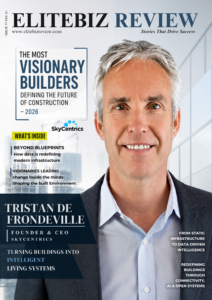
The construction industry has always been associated with permanence. Steel frameworks, concrete foundations, mechanical systems, and infrastructure are built to endure for decades, sometimes generations. Yet for all its durability, the industry has historically lacked one defining trait of the modern era: intelligence. Buildings are designed, constructed, and handed over, often becoming static assets the moment they are occupied. Behind walls and inside mechanical rooms, disconnected systems operate in isolation, producing little usable data and offering almost no real time visibility into performance. For decades, buildings have functioned as black boxes, expensive, essential, and largely unknowable once operational. That reality is changing.
A new class of innovators is challenging the idea that buildings should merely stand still. They are reimagining the built environment as something dynamic, connected, responsive, and continuously improving. Among the most compelling voices leading this transformation is Tristan de Frondeville, CEO of SkyCentrics.
Tristan’s journey to becoming a transformative force in construction technology is as unconventional as the ideas he champions today. He has been a street performer and juggler across the United States and Europe, a high school math teacher working to bring computers and internet access into classrooms, a consultant collaborating with Apple and SRI International, a startup engineering leader solving GPS challenges under extreme constraints, and ultimately, a founder helping redefine the relationship between buildings, energy, and intelligence. Every chapter of that journey has shaped the way he thinks about systems, people, and innovation.
Today, those experiences converge in one ambitious mission: turning buildings from static structures into intelligent living systems. At the heart of Tristan’s vision is a simple but powerful belief: the buildings that win in the next decade will not simply be the best constructed. They will be the most connected, the most data aware, and the most continuously optimized. And if that future arrives sooner than expected, Tristan de Frondeville will be one of the reasons why.
An Unconventional Path to Visionary Leadership
Few CEOs in the construction and infrastructure space can say their professional foundation was built while juggling in the streets of Europe. Yet for Tristan de Frondeville, that experience was more than youthful adventure. It was an early masterclass in leadership and human psychology. Performing in public spaces teaches one immediate truth: attention is never given; it is earned. If you cannot engage people quickly, clearly, and emotionally, nothing moves forward. That lesson has remained central to Tristan’s leadership style. Timing matters. Clarity matters. Connection matters. Whether pitching investors, aligning teams, or shifting an industry’s mindset, the mechanics are surprisingly similar.
His next chapter as a high school math teacher sharpened a different dimension of leadership. Teaching was not simply about delivering information; it was about unlocking potential. It required creating environments where every student, not just the strongest, had an opportunity to grow and succeed. That mindset deeply influenced how Tristan builds teams and companies today. Leadership, in his view, is not about spotlighting top performers while the rest struggle to keep up. It is about designing systems where everyone can contribute and improve.
That period also marked his first serious intersection with technology. Tristan began writing grants to bring computers and internet access into classrooms, translating a vision for modern education into funded, operational reality. That experience taught him an entrepreneurial lesson that still applies today: ideas alone do not create change. The ability to articulate value, secure support, and execute on the vision is what turns ambition into impact.
From education, Tristan moved into consulting, where he worked with Apple and SRI International on a patent related to teaching calculus concepts through software to middle school students rather than waiting until high school or college. Even then, he was focused on using technology to break old assumptions and create earlier, broader access to complex systems.
He later entered the startup world, leading engineering teams and developing GPS tracking systems under severe technical and operational constraints. In those environments, there is no room for wasted effort. Resources are scarce, timelines are compressed, and priorities become brutally clear. “You learn to prioritize what actually matters.” That discipline, knowing what to build, what to delay, and what truly drives value, became foundational to his approach as a founder.
The Moment Buildings Became the Mission
Tristan’s entry into construction and infrastructure did not come through architecture or contracting. It came through connected devices. Specifically, thermostats. Long before smart thermostats became mainstream through companies like Nest Labs, Tristan and his team were exploring a more fundamental question: how do machines interact intelligently with the electrical grid? That question led directly to the creation of SkyCentrics.
The traditional electrical grid was designed for a different era: centralized generation, one way power delivery, and relatively predictable demand. But the modern energy landscape is increasingly decentralized and dynamic. Renewable generation, batteries, electric vehicles, and distributed energy resources have introduced levels of complexity the old grid model was never designed to manage.
As Tristan explains, “The next 100 years of the grid won’t look anything like the last 100-they will be defined by dynamic, machine level intelligence.”
SkyCentrics began by embracing open standards like CTA-2045 EcoPort, essentially a “USB port for energy devices.” This allowed machines to react intelligently to grid signals. Devices could consume more energy when power was cheap and clean and reduce usage when energy was expensive or carbon intensive.
Initially, these ideas applied to water heaters using thermal storage to shift consumption patterns. But the company’s real breakthrough came in commercial buildings. Inside those environments, Tristan and his team discovered a far larger and more urgent problem. Buildings were filled with disconnected legacy systems. BACnet and Modbus controlled internal infrastructure. OpenADR managed grid communication. HVAC, electrical, water, and mechanical systems all operated in isolation.
The building itself had no unified intelligence. So SkyCentrics built a Linux based platform capable of connecting to every major system in a building and bringing all that data together in one place.
For the first time, building owners could see what was happening in real time, optimize performance continuously, and make decisions based on live intelligence rather than assumptions. That moment changed everything.
Why Data Is the Real Revolution
Much of today’s market conversation centers on artificial intelligence, but Tristan’s perspective cuts through the hype with unusual clarity. “AI doesn’t transform buildings-data does. AI is just what happens next.” It is one of the most important distinctions in the industry today. For decades, buildings generated little to no usable data. Information remained trapped inside proprietary systems or inaccessible interfaces. Operators often relied on guesswork, fixed schedules, or reactive maintenance instead of real time intelligence.
By unlocking building data, SkyCentrics has positioned itself at the center of a much larger transformation. AI is fundamentally a data engine. Without clean, structured, and accessible data, AI cannot create meaningful value. With it, entirely new possibilities emerge. “What used to be a ‘nice to have’-building connectivity-is now critical infrastructure.”
Today, low cost Linux based devices can sit inside buildings and pull real time data from HVAC systems, water systems, electrical systems, and distributed energy assets. That data enables continuous optimization, predictive maintenance, anomaly detection, and intelligent orchestration of increasingly complex technologies like heat pumps and energy storage systems.
Tristan’s perspective has evolved from seeing this as product innovation to recognizing it as systemic transformation. Without data, there is no AI. Without AI, future optimization remains limited. And without foundational infrastructure, neither can scale.
Building Open Ecosystems, Not Closed Products
One of the most defining aspects of Tristan’s vision is his commitment to open systems. SkyCentrics became a founding member of the Coalition for Smarter Buildings, now part of the Linux Foundation, the world’s largest open source software organization. Through initiatives like the Open Building Stack, Tristan and his team are helping define how multi vendor, interoperable building systems will operate in the future. “Open standards and open source don’t just reduce cost-they unlock entire ecosystems of innovation.” This philosophy reflects a much bigger ambition than building a product.
Tristan is helping build infrastructure that others can innovate on. He compares it to the evolution of software itself. The leap from mainframes to desktop software to mobile apps did not happen because ideas suddenly improved. It happened because infrastructure improved. Innovation became easier, cheaper, and more accessible to more people.
Now he sees the same inflection point in buildings. SkyCentrics already has an “app store” model emerging on its platform, where engineering partners can write Python applications, containerize them, and deploy them directly into buildings. That infrastructure could unleash an entirely new generation of building focused innovation.
Leadership Built on Trust, Accountability, and Quality
As a founder and CEO, Tristan’s leadership philosophy is deeply human centered. Internally, he prioritizes cultures where people feel heard, trusted, and accountable. “Innovation doesn’t happen in rigid hierarchies-it happens in environments where ideas can move freely.” He has seen organizations prioritize arbitrary deadlines over product quality, often leaving the most conscientious people to carry the burden. SkyCentrics operates differently. “We don’t always get it on time-but we always get it right.” That principle reflects a commitment to long term trust over short term speed.
Tristan also believes in disciplined communication. Important external messaging is reviewed by multiple team members, not just for accuracy but to build collective intelligence. Another defining concept in his leadership is what he calls building a “bird cage” of relationships, a network of forward thinking leaders shaping the future together. This philosophy draws inspiration from Guy Kawasaki and his evangelist model: empower the people already eager to innovate and let them lead change. “You don’t scale innovation by pushing-it scales by enabling the people already trying to change the system.”
AI and Cybersecurity Will Define the Next Era
When Tristan looks ahead, two forces stand above the rest: artificial intelligence and cybersecurity. AI enables something the building industry has never truly had: continuous commissioning. Instead of configuring systems once and hoping they remain efficient, operators can now optimize buildings continuously in real time. He offers an analogy that makes the concept instantly clear. “Running a building without real time data is like driving a car with no dashboard.”
Cars are maintained based on miles driven and performance signals. Buildings have historically been maintained by calendar schedules and assumptions. Now, operators can track actual system run times, performance trends, and degradation patterns. Maintenance becomes predictive instead of reactive. Operations become dynamic instead of static.
At the same time, cybersecurity is becoming essential. Most legacy building systems were never designed to be secure. As they become connected, vulnerabilities multiply. By leveraging Linux based infrastructure and open source principles, SkyCentrics is bringing modern security models into historically insecure environments. Just as Linux became the backbone of the internet through transparency and collaborative improvement, Tristan believes the same model can secure the future of buildings.
A New Generation of Builders and Innovators
For emerging leaders in construction and infrastructure, Tristan sees extraordinary opportunity where IT and operational technology converge. His advice is simple: lean into that intersection. Bring modern principles like modularity, interoperability, and open standards into industries that have historically been closed. “The biggest opportunities are always where old systems meet new thinking.” He also believes the industry must become more exciting to attract the next generation. Buildings represent one of the world’s largest untapped opportunities for innovation. They are meaningful, high impact systems touching energy, sustainability, economics, and human experience. And with the right infrastructure, innovation can scale exponentially.
As Tristan notes, the explosion of innovation from mainframes to desktops to mobile platforms happened because infrastructure democratized access. The same thing can happen in buildings. With open infrastructure in place, the next generation of innovators, from major firms to high school students, could build applications and intelligence layers that redefine the built world.
From Static Structures to Living Systems
Looking toward the next decade, Tristan sees a complete redefinition of the building lifecycle. The traditional handoff from design to construction to operations will fundamentally change. Data will persist across every stage. “The buildings that win in the next decade won’t just be well built-they’ll be continuously optimized.”
His vision is a world where every building is intelligent, connected, and responsive from day one. Where systems communicate. Where maintenance becomes predictive. Where energy usage adapts dynamically. Where operations become increasingly autonomous. And where buildings are no longer static assets but living systems.
The legacy Tristan de Frondeville hopes to leave is not simply a company or a product. It is the infrastructure, standards, and ecosystem that make this future possible. “Buildings shouldn’t be black boxes-they should be living systems.” And in the next era of construction, the leaders who matter most will not only build structures that stand tall-they will build systems that think, adapt, and improve long after the ribbon is cut. Tristan de Frondeville is not just imagining that future. He is building the intelligence layer that may define it.