
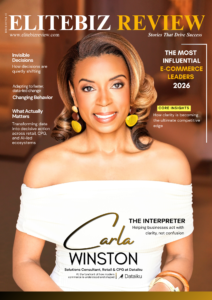
At a time when e-commerce is being redefined by artificial intelligence, automation, and rapidly shifting consumer expectations, the ability to work with data is no longer enough. What distinguishes impactful organizations today is not access to information, but the ability to interpret it, translate it, and act on it with precision.
For Carla Winston, Solutions Consultant – Retail & CPG at Dataiku, this transformation represents something deeper than a technological shift. It reflects a fundamental change in how businesses understand decision-making, customer engagement, and long-term growth.
Her work sits at the intersection of retail, consumer packaged goods (CPG), and advanced data solutions – an intersection where complexity is constant, but clarity is rare. What defines her approach is a belief that has guided her career from the very beginning: the true value of data lies not in its volume, but in its ability to drive meaningful, measurable action.
From Category Management to Data Stewardship
Carla Winston’s career began in the category management space within CPG, where she operated in external-facing roles that required both analytical rigor and strategic influence. These roles placed her at the center of retailer partnerships, working across a diverse set of data sources – from syndicated tools and retailer-provided datasets to internal analytics platforms.
It was in this environment that she developed a foundational capability that would shape her career: the ability to translate complex data into clear, fact-based narratives that drive decisions. This was not simply about analysis. It was about influence – ensuring that insights resonated with stakeholders and led to action.
As her experience deepened, so did her perspective. Spending significant time collaborating with retailers, she began to see her role evolving beyond that of an analyst or category leader. What emerged was a broader sense of responsibility – one centered not just on generating insights, but on shaping how those insights were interpreted and applied.
That realization marked a turning point. She began to view herself as a data steward – someone accountable for ensuring that data is not only accurate, but also meaningful, accessible, and actionable. It was a shift from working with data to owning its impact. At the same time, the industry itself was undergoing rapid transformation. The rise of artificial intelligence, automation, and advanced analytics was fundamentally changing how organizations operated and competed.
Carla recognized that while her foundation in traditional analytics and storytelling was strong, the landscape was evolving quickly. To remain effective – and to continue delivering value – she needed to expand her capabilities.
This was not simply about acquiring new technical skills. It was about extending her ability to bridge a gap she increasingly observed in the industry: the disconnect between sophisticated data science and practical, business-facing execution.
Her transition into roles focused on e-commerce transformation and advanced analytics was therefore intentional. It allowed her to operate at the convergence of strategy and technology – bringing together deep industry knowledge with emerging capabilities to drive meaningful impact.
Bridging Advanced Analytics with Real-World Execution
In her role at Dataiku, Carla works closely with organizations across the retail and CPG landscape, guiding them in adopting advanced analytics and artificial intelligence in ways that are both strategic and practical. Her approach begins with clarity. Rather than starting with tools or technology, she focuses on identifying high-impact use cases – areas where data and AI can deliver measurable business value. Through structured ideation sessions, she helps organizations define a clear path forward, aligning stakeholders across functions and ensuring that priorities are shared and understood.
This alignment is critical. In many organizations, data initiatives fail not because of technological limitations, but because of fragmentation – different teams working toward different objectives without a unified strategy. By bringing these groups together, Carla ensures that data becomes a unifying force rather than a siloed function. From there, the work shifts toward activation. Across the retail value chain, she partners with teams to turn strategy into execution – leveraging data to optimize sales, refine marketing approaches, enhance operations, and ultimately improve the customer experience.
Whether the focus is assortment planning, pricing optimization, or simplifying the shopper journey, the objective remains consistent: to translate insights into scalable, actionable decisions that can adapt to the fast-moving nature of e-commerce.
Agentic Commerce and the Next Phase of E-Commerce Evolution
One of the most transformative shifts Carla highlights is the rise of agentic commerce – a model defined by the integration of AI-powered agents into the shopping experience. These systems are no longer limited to supporting roles. Increasingly, they act as co-pilots – and in some cases decision-makers – on behalf of consumers. From product discovery and comparison to purchase decisions, AI agents are beginning to shape how consumers interact with brands.
This evolution represents a critical inflection point. As AI takes on a more active role in the customer journey, the traditional dynamics of influence begin to change. Brands and retailers are no longer engaging solely with human decision-makers. They are also engaging with systems that interpret data, evaluate options, and make recommendations.
In this context, visibility is no longer guaranteed. Organizations that proactively adapt – by structuring their data, refining their content, and aligning their strategies with AI-driven ecosystems – have the opportunity to extend their influence in new and meaningful ways. Those that do not risk losing relevance at key decision points.
Carla emphasizes that in this new environment, customer experience is no longer defined by isolated touchpoints. Instead, it is shaped by how effectively an organization’s data – across the entire retail value chain – is connected and activated in real time.
This is where modern data platforms become essential. By ensuring that data is accurate, interoperable, and accessible, these platforms enable organizations to deliver consistent, high-quality experiences while aligning automated decision-making with broader business objectives. Looking ahead, agentic commerce is poised to unlock new levels of agility across supply chains, marketing strategies, and operational processes. However, it also raises the bar.
Data quality, governance, and precision will no longer be supporting elements – they will be defining competitive advantages.
The Human Challenge Behind Data Transformation
Despite the rapid advancement of technology, Carla is clear about one thing: the most significant challenge organizations face in becoming truly data-driven is not technological – it is human. Embedding artificial intelligence and scaling data-driven operations require organizations to invest deeply in their people. Employees are ultimately responsible for interpreting insights, validating outputs, and translating recommendations into action. Without strong data literacy, even the most advanced tools can fall short.
Equally important is change management. Adopting new technologies often requires shifts in mindset, processes, and ways of working. Organizations must create environments where teams feel equipped and empowered to engage with data, rather than overwhelmed by it.
At the same time, the competitive landscape continues to intensify. Retailers and CPG brands are under constant pressure to differentiate themselves in a crowded market. Achieving this differentiation requires more than infrastructure – it requires the ability to generate meaningful insights that drive personalization, engagement, and customer loyalty at scale.
The organizations that succeed are those that bring together three critical elements: empowered teams, strong data foundations, and the right technology. When these elements align, data becomes not just a resource, but a driver of sustained growth.
Redefining Customer Engagement in a Digital-First World
As the digital marketplace evolves, Carla identifies two forces that are fundamentally reshaping how brands interact with customers. The first is the growing role of AI as an intermediary. AI agents are increasingly influencing how consumers discover products, evaluate options, and make decisions. This shifts the nature of engagement, requiring brands to think beyond traditional marketing approaches.
It is no longer sufficient to craft messages solely for human audiences. Organizations must also ensure that their data, content, and positioning are optimized for systems that interpret and act on behalf of those audiences. The second force is the fragmentation of attention. Consumers today are exposed to an overwhelming volume of content across multiple platforms. Attention spans are shrinking, and competition for engagement is intensifying.
In this environment, precision becomes critical. Success depends on delivering the right message, at the right time, through the right channel. Brands that can achieve this level of precision are better positioned to capture attention, convert interest into action, and build lasting relationships with their customers.
Balancing Personalization, Experience, and Efficiency
One of the defining challenges in modern e-commerce is balancing personalization with operational efficiency. Carla approaches this challenge by anchoring it in true customer-centricity. By leveraging data to develop a holistic understanding of customer behavior, intent, and preferences, organizations can deliver personalization that feels relevant and meaningful. This not only enhances the customer experience but also builds trust.
At the same time, operational efficiency is achieved through the thoughtful integration of technology. Scalable data platforms, automation, and cross-functional alignment enable organizations to deliver personalized experiences without creating unnecessary complexity or fragmentation. When customer insights are embedded directly into decision-making processes, organizations can streamline operations while maintaining consistency across touchpoints.
Turning Insight into Action: A Leadership Perspective
A defining aspect of Carla’s work is her ability to translate complex data into actionable strategies that deliver measurable business value. Her experience spans the integration of multiple data sources, including retailer shopper data, syndicated datasets, and customer analytics tools. By synthesizing these inputs, she helps organizations move beyond descriptive reporting toward insight-led decision-making.
However, what sets her approach apart is not just analytical capability – it is communication. She places a strong emphasis on crafting clear, credible narratives that align data with business objectives. This ensures that insights are not only understood, but also acted upon.
The Power of Simplicity in Driving Impact
One of the most influential lessons in Carla’s career came from an early experience that reshaped her approach to leadership. While preparing for a customer presentation, she found herself overcomplicating the story – layering in extensive data and analysis that ultimately obscured the core message.
A colleague offered a simple piece of advice: “keep it simple.” That moment became a guiding principle. It reinforced the idea that leadership is not about presenting more information – it is about making information meaningful and actionable. This principle was later brought to life in a large-scale omnichannel transformation initiative, where Carla played a central leadership role.
Acting as the “quarterback,” she led efforts to align cross-functional teams around a shared objective: improving how organizations engage customers across channels to drive sales growth. The process began with customer segmentation and a detailed analysis of customer lifetime value. From there, she worked closely with analytics teams to integrate multiple data sources, including transaction history, product attributes, and digital engagement signals. What emerged were clear, actionable insights that identified which channels and touchpoints were most effective for specific customer segments.
However, the true impact came from activation. Rather than simply presenting findings, Carla translated the insights into an interactive workshop, creating a collaborative environment where teams could explore, challenge, and apply the data. This approach ensured alignment and ownership across stakeholders. Over a 12-week period, the strategy was tested and validated, demonstrating measurable improvements in sales performance and providing a scalable framework for future initiatives. This experience reinforced a belief that continues to guide her work: Impact is not driven by complexity – it is driven by clarity, alignment, and execution.
Preparing the Next Generation of Leaders
For professionals aspiring to build careers in e-commerce transformation and data strategy, Carla emphasizes the importance of adaptability and curiosity. The pace of change in the industry requires individuals to be nimble – capable of learning, unlearning, and evolving in response to new challenges and opportunities.
Equally important is a hands-on approach to technology. Understanding concepts is no longer sufficient. Professionals must actively engage with tools, experiment with new platforms, and develop a practical understanding of how technology can be applied to solve real-world problems. This combination of adaptability and curiosity enables individuals to not only keep pace with change, but to lead it.
A Vision for Strategic Impact
Looking ahead, Carla Winston is focused on continuing to grow her capabilities while contributing to the broader evolution of the retail and e-commerce landscape. She aims to serve as a voice for strategic change – helping organizations rethink how they engage customers, structure their go-to-market strategies, and translate data into action.
At the heart of this vision is a commitment to building frameworks that provide clarity in an increasingly complex environment. Her work is driven by the belief that meaningful progress comes from the integration of strategy, innovation, and execution.
A Leadership Philosophy Rooted in Collaboration and Growth
Across her career, Carla has developed a deep appreciation for collaboration and shared success. She has led and coached high-performing teams with a focus on collective accountability, measurable outcomes, and mutual value creation. Her leadership philosophy recognizes that the most impactful results are achieved when teams are aligned around common goals and empowered to contribute meaningfully.
This perspective is complemented by a strong focus on continuous growth – both personally and professionally. She remains committed to evolving as a leader and partner, anticipating emerging trends and translating them into strategic action that benefits both organizations and the broader industry.
Shaping the Future of Data-Driven Commerce
As e-commerce continues to evolve, Carla Winston’s work reflects a broader transformation in how organizations approach data, technology, and growth. It is a shift from accumulation to activation, from complexity to clarity, and from insight to impact. In a world where data is abundant but actionable insight is rare, her perspective offers a clear and compelling direction forward:
The organizations that succeed will not be those with the most data, but those that can turn it into meaningful, measurable outcomes.