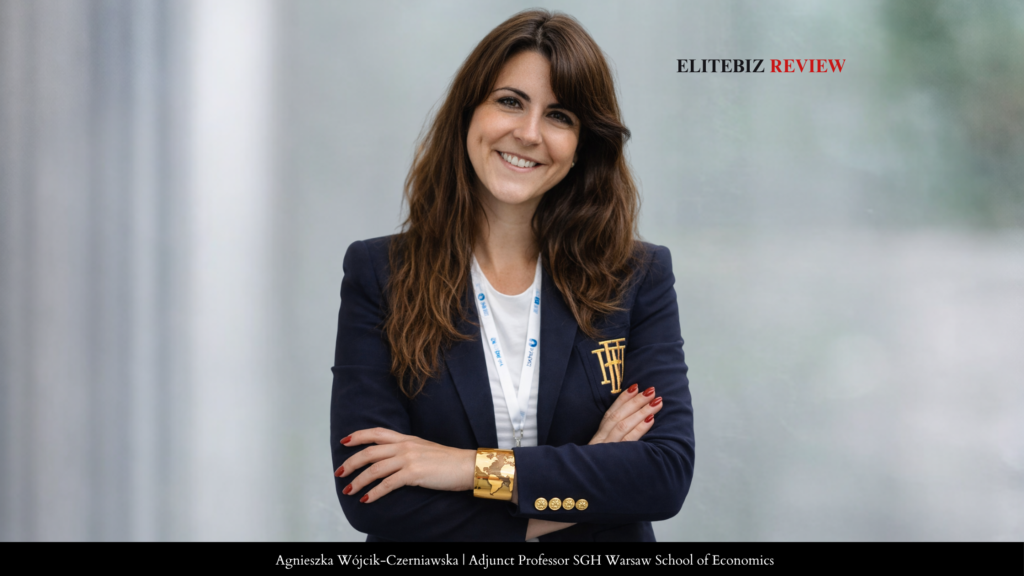
In an era defined less by stability and more by constant transformation, the role of leadership – particularly in academia – has moved beyond knowledge dissemination into something far more complex. It now demands the ability to interpret interconnected systems, anticipate structural shifts, and guide others through uncertainty with both intellectual clarity and human depth. At this intersection of thought, resilience, and responsibility stands Agnieszka Wójcik-Czerniawska, Adjunct Professor at SGH Warsaw School of Economics.
Her work does not conform to traditional academic boundaries. Instead, it reflects a deliberate effort to understand and navigate the evolving architecture of global systems – where economics, governance, technology, and society continuously reshape one another. What defines her journey is not only the breadth of her expertise, but the coherence with which she connects these domains into a forward-looking perspective.
This is not a story of linear progression, but of layered evolution – where intellectual curiosity, interdisciplinary depth, and personal resilience converge to shape a leadership philosophy grounded in substance, long-term impact, and meaningful contribution.
An Intellectual Foundation Built Across Disciplines
From the outset, Agnieszka Wójcik-Czerniawska’s academic path was shaped by a refusal to remain confined within a single discipline. Her curiosity was not limited to isolated frameworks; instead, it extended toward understanding how systems interact and evolve under the influence of broader forces.
“My journey into academia has been shaped by a continuous curiosity about how complex systems evolve under the influence of technological, economic, and societal change,” she explains. This perspective became the cornerstone of her intellectual development, guiding her toward an interdisciplinary approach that integrates multiple dimensions of analysis.
Her academic credentials reflect this multidimensional thinking. With three Master’s degrees in economics, political studies, and anthropology, she cultivated a layered understanding of global systems. Economics provided analytical precision, political studies offered insights into governance and institutional dynamics, and anthropology introduced a nuanced understanding of cultural and social contexts. Together, these disciplines enabled her to approach challenges not as isolated problems, but as interconnected phenomena requiring integrated solutions.
This foundation was further strengthened by a PhD in economics, an MBA completed in Spain, and more than ten postgraduate programs across diverse fields. Rather than viewing education as a finite process, she approached it as a continuous expansion of perspective – an ongoing effort to refine her ability to interpret complexity.
From Knowledge Creation to Meaningful Interpretation
A defining shift in her career emerged when she began to view academia not solely as a space for generating knowledge, but as a platform for interpreting and translating complexity into meaningful insights.
She recalls this realization as a turning point – one that reshaped her role as both a researcher and educator. The emphasis moved from producing academic output to ensuring that knowledge could be understood, applied, and extended beyond institutional boundaries.
This transition led her to focus on areas such as digital transformation, algorithmic governance, and the ethical dimensions of economic systems. These are not static fields; they are dynamic, evolving in response to technological advancement and societal change. Engaging with them requires not only technical expertise, but also the ability to anticipate implications and contribute to forward-looking discussions.
Her active participation in international conferences, workshops, and academic networks has played a crucial role in this evolution. These engagements allow her to observe how theoretical frameworks manifest in real-world contexts, across different cultures and institutional environments. This constant exchange between theory and practice reinforces her ability to remain both academically rigorous and practically relevant.
Teaching as a Framework for Independent Thought
In a world where access to information is immediate and abundant, Agnieszka Wójcik-Czerniawska approaches education not as a process of transmission, but as a process of transformation. Her teaching philosophy centers on developing the ability to think independently, adapt to uncertainty, and engage critically with complex issues.
“My teaching philosophy is grounded in the belief that education should develop independent thinking and adaptability rather than simply transmit knowledge,” she explains.
To achieve this, she employs problem-based and scenario-driven learning methodologies. Students are placed in situations that require them to analyze ambiguity, make decisions, and justify their reasoning. This approach shifts the focus from passive absorption to active engagement, encouraging students to develop confidence in navigating complexity.
Three core dimensions define her teaching: critical thinking, strategic imagination, and responsibility. Critical thinking involves questioning assumptions and identifying underlying structures. Strategic imagination enables students to anticipate future developments and move beyond immediate constraints. Responsibility ensures that decisions are evaluated not only in terms of efficiency, but also in relation to their broader ethical and societal implications.
Mentorship extends this philosophy further. Rather than providing predefined pathways, she supports students in developing their own analytical frameworks and encourages them to challenge established paradigms. This is particularly important in rapidly evolving fields such as artificial intelligence and the digital economy, where adaptability and continuous learning are essential.
Leadership as Intellectual Coherence and Direction
Balancing research, teaching, and societal engagement requires more than time management – it requires a cohesive vision that integrates these elements into a unified trajectory.
Agnieszka approaches these responsibilities as interconnected rather than separate. Research informs teaching, teaching refines ideas, and broader engagement extends their impact. This integrated approach allows her to maintain both depth and relevance in her work.
Her forward-looking perspective is shaped by a focus on structural transformations. Artificial intelligence, circular economy models, and evolving governance systems are not incremental developments; they represent fundamental shifts that redefine how institutions and economies operate.
Leadership, in this context, is not defined by position, but by clarity of purpose and the ability to connect ideas into a meaningful framework. It involves guiding intellectual direction, maintaining coherence across diverse areas of inquiry, and contributing to discussions that shape the future of global systems.
Resilience, Identity, and the Redefinition of Leadership
The challenges Agnieszka encountered throughout her career were often subtle and structural, reflecting broader dynamics within academic and professional environments. They were not always explicit, but they required navigation, awareness, and strategic positioning.
Rather than conforming to existing models of leadership, she chose to redefine them. Her approach is grounded in intellectual credibility, consistency, and long-term impact rather than immediate recognition.
“My leadership philosophy is based on three principles: substance over form, long-term impact over immediate recognition, and collaboration over competition,” she states.
These principles were not formed in isolation; they were shaped by experience. One of the most defining moments in her life came when she became a widow at the age of 36, with two young children. This experience introduced a level of responsibility and complexity that extended far beyond professional challenges.
It required resilience, adaptability, and a deep sense of purpose. At the same time, it reinforced her ability to navigate uncertainty and maintain direction under pressure. Rather than disrupting her trajectory, it became a source of strength – shaping her understanding of leadership as something that extends beyond competence into responsibility and perseverance.
The Role of Family in Shaping Perspective
While her professional achievements are significant, Agnieszka’s journey is equally shaped by personal influences that have grounded and guided her path. Her mother stands as a central source of inspiration, embodying resilience, discipline, and a deep respect for knowledge. This influence has been instrumental in shaping both her work ethic and her commitment to continuous learning.
Her sons, Victor and Alexander, represent another dimension of her perspective. Their curiosity and openness serve as a constant reminder of the importance of adaptability and engagement with new ideas. They reinforce her belief that development is not an isolated process, but one that is shared across generations. Whenever possible, she integrates her professional experiences with her family life, allowing them to participate in international environments and cultural exchanges. This approach reflects a broader philosophy – one that views learning not as confined to institutions, but as a continuous, lived experience.
Global Perspective and the Power of Language
An often overlooked yet critical aspect of Agnieszka’s development is her linguistic capability. With proficiency in 12 languages, she has positioned herself to engage deeply within international contexts.
Language, in her experience, is not merely a tool for communication; it is a gateway to understanding perspectives, cultures, and systems at a more nuanced level. It enhances her ability to participate in global dialogue and to contribute meaningfully to discussions that transcend national boundaries.
This global perspective is essential in an interconnected world where challenges and solutions are rarely confined to a single context. It enables her to operate with a level of awareness and adaptability that strengthens both her academic and professional impact.
Reimagining the Future of Higher Education
The landscape of higher education is undergoing a transformation driven by technological innovation and global challenges. Agnieszka views this shift not as a disruption, but as an opportunity to redefine the role of academic institutions.
Artificial intelligence is reshaping how knowledge is accessed and applied, shifting the focus toward higher-order competencies such as critical thinking, creativity, and ethical reasoning. At the same time, interdisciplinarity is becoming increasingly important, as complex problems require integrated approaches.
Universities are evolving into platforms for innovation and dialogue, connecting academia with business, policy, and technology sectors. This transformation requires a careful balance – adapting to change while maintaining intellectual depth and independence.
Mentorship and the Empowerment of Future Women Leaders
Mentorship, in Agnieszka’s view, is about creating conditions for growth rather than prescribing outcomes. It involves building intellectual confidence, fostering strategic awareness, and supporting individuals in developing a clear sense of direction.
She places particular emphasis on empowering young women to recognize their potential and engage in leadership roles. This includes encouraging participation in research, international dialogue, and professional development.
“Leadership is not defined by position, but by the ability to influence through ideas, consistency, and long-term engagement,” she emphasizes.
By reframing how individuals perceive their capabilities, mentorship becomes a powerful tool for enabling transformation – not only at an individual level, but across broader systems.
A Vision Rooted in Integration and Impact
Rather than defining her work through a single achievement, Agnieszka views impact as something that emerges from consistency, depth, and the ability to connect ideas across disciplines.
Her research focuses on the intersection of digital transformation, governance, and economic systems – areas that are central to understanding how institutions evolve in response to technological change. This work is not limited to analysis; it aims to contribute to future-oriented thinking and informed decision-making.
Her perspective on leadership extends beyond professional roles. It encompasses the integration of knowledge, experience, and values into a cohesive approach that prioritizes long-term impact and meaningful contribution.
The Future Leader: Navigating Complexity with Purpose
Looking ahead, Agnieszka identifies a set of competencies that will define effective leadership in a rapidly changing world. Systems thinking, adaptive decision-making, ethical awareness, and a global perspective are no longer optional – they are essential.
Equally important are resilience and intellectual courage. The ability to remain consistent in one’s values while navigating uncertainty is what ultimately enables long-term success.
She emphasizes that leadership is not about visibility alone, but about the capacity to create meaningful and lasting impact through sustained effort and thoughtful engagement.
A Closing Perspective: Where Knowledge Meets Purpose
At the core of Agnieszka Wójcik-Czerniawska’s journey is a belief that leadership is formed at the intersection of knowledge, experience, and values. It is shaped not only by professional achievements, but by the ability to navigate complexity with clarity and purpose.
Her work reflects a commitment to connecting academic research with real-world transformation, particularly in areas that define the future of global systems. At the same time, her personal experiences have reinforced the importance of resilience, responsibility, and meaningful relationships.
Education, in her view, is one of the most powerful forces shaping both individual trajectories and societal outcomes. It is not merely about acquiring knowledge, but about developing the capacity to think critically, act responsibly, and engage constructively with the world.
In a time of rapid change, this perspective offers a steady and forward-looking framework – one that emphasizes depth over speed, substance over visibility, and impact over immediacy.
True leadership, as her journey demonstrates, is not defined by a single moment or achievement. It is built over time, through consistency, reflection, and the courage to engage with complexity while remaining grounded in purpose.