
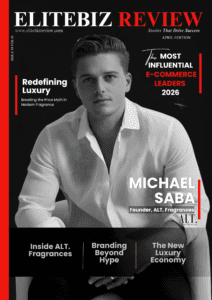
(How ALT. Fragrances is challenging legacy pricing models and building a new standard for accessible luxury)
Luxury has long operated within a framework that few questioned – high price equates to high value. In categories like fragrance, that equation has been reinforced for decades through branding, exclusivity, and controlled distribution. But for Michael Saba, Founder of ALT. Fragrances, that model was never entirely convincing. His journey into the industry didn’t begin with a strategic plan to disrupt it – it began with a simple, personal experience that exposed a much larger gap.
While in college, Saba came across Creed Aventus, a fragrance widely regarded as one of the most iconic scents in the market. The appeal was immediate. The quality, the composition, the identity – it all resonated. But the price, exceeding $400 per bottle, created a disconnect that was difficult to ignore. For Saba, the issue wasn’t just affordability; it was the realization that the cost of the product did not align with its intrinsic value.
That moment became the foundation for a deeper observation about the industry. Many fragrances retailing between $300 and $500 were produced at a fraction of that cost, with the majority of the markup driven by branding, positioning, and traditional retail structures rather than the formulation itself. At the same time, consumer behavior was evolving. Buyers were becoming more informed, more analytical, and increasingly comfortable purchasing products online without relying on legacy retail experiences.
This convergence – an outdated pricing structure and a more informed consumer – created a clear opportunity. ALT. Fragrances was built to address that gap, offering high-quality fragrances inspired by well-known scents at a significantly more accessible price point, without compromising on performance.
Proving the Model Through Customer Behavior
In the early stages of ALT., the priority was not rapid expansion or brand visibility. It was validation. For Saba, the most meaningful metric was not initial sales, but repeat purchases. A first transaction could be driven by curiosity or price sensitivity, but a second purchase indicated something far more important – product satisfaction.
Once ALT. began to see strong repeat purchase behavior, it confirmed that customers were not simply experimenting with the brand; they were returning because the product delivered. In a category as subjective and experience-driven as fragrance, this was a critical milestone. It demonstrated that the brand’s value proposition – quality at a more accessible price – was not only compelling, but sustainable.
This validation provided the confidence to scale. From that point forward, growth was approached with a clear framework: identify what works, optimize it, and expand strategically without compromising the core product experience.
Building a Scalable Growth Engine
ALT.’s growth has been driven by a highly disciplined approach to performance marketing. Rather than relying on traditional brand-building strategies alone, the company built a system centered on continuous testing, rapid iteration, and data-driven decision-making.
Creative is at the core of this system. Campaigns are not treated as static assets but as evolving components that are constantly refined based on performance. The team tests aggressively, analyzing engagement, conversion, and return metrics in real time. This allows ALT. to scale successful campaigns quickly while eliminating underperforming ones without delay.
Data plays a central role in this process. Metrics such as customer acquisition cost, repeat purchase rate, lifetime value, and return on ad spend are monitored closely. These indicators provide immediate feedback on performance and guide decision-making across marketing and product strategies.
However, quantitative data alone is not sufficient. Customer feedback serves as an equally important input. Reviews, support interactions, and user-generated content reveal patterns that data alone cannot fully capture – insights into product longevity, packaging expectations, and overall customer experience. By combining these qualitative signals with performance metrics, ALT. is able to make informed decisions that align closely with consumer needs.
Establishing Trust Through Clarity and Consistency
In a market where consumers may be skeptical of alternative fragrance brands, trust is a critical factor. ALT.’s approach to building that trust has been grounded in transparency. From the beginning, the brand has been clear about its offering: high-quality fragrances inspired by well-known scents, delivered at a fraction of the traditional cost.
This clarity removes ambiguity and sets accurate expectations. Once those expectations are established, the responsibility shifts to the product itself. Performance becomes the defining factor. Longevity, ingredient quality, and consistency across batches are essential to maintaining credibility.
Over time, this consistency has driven repeat purchases, which serve as the strongest validation of trust. In addition, social proof has played a significant role in reinforcing the brand’s reputation. Customer reviews, user-generated content, and creator partnerships provide authentic validation, helping new customers feel confident in their purchasing decisions. Through this combination of transparency and performance, ALT. has positioned itself not merely as an alternative, but as a reliable and credible option within the fragrance market.
Competing on Value, Not Perception
While many fragrance brands emphasize storytelling, heritage, or visual identity, ALT. has focused on a different set of priorities: value, performance, and consistency. This differentiation is intentional and reflects a broader shift in consumer expectations.
Quality remains the foundation. Maintaining a high standard across all products ensures that the brand delivers on its promise. At the same time, control over manufacturing allows ALT. to operate with greater speed, identifying trends and bringing products to market more efficiently than traditional competitors.
Pricing is another key differentiator. By eliminating unnecessary markups, the brand is able to offer a significantly stronger price-to-quality ratio. This makes the value proposition clear and accessible to a wider audience.
Marketing, meanwhile, is driven by experimentation. The team continuously tests new creative approaches, adapting quickly to changing consumer preferences and platform dynamics. This willingness to evolve is essential in a digital-first environment where attention is limited and competition is constant.
Education also plays a strategic role. By helping consumers understand how fragrance pricing works, ALT. reinforces its positioning and builds deeper trust. When customers understand the economics behind the industry, the brand’s value becomes even more apparent.
Expanding Beyond Digital into Physical Retail
A significant turning point for ALT. came in 2024 with the launch of its first retail location. This marked the brand’s transition from a purely e-commerce business to an omnichannel model. The move was not simply about expansion, but about enhancing the customer experience.
Fragrance is inherently sensory, and physical retail provides an opportunity for customers to engage with products in a more direct and immersive way. The success of the first location led to rapid expansion, with the company growing to 28 stores across Florida, New York, New Jersey, North Carolina, and Texas.
This physical presence complements the brand’s digital foundation, creating a more integrated customer journey. At the same time, ALT. has continued to expand its reach through additional channels. In early 2025, the company launched on Amazon and entered wholesale partnerships with retailers such as Urban Outfitters and Sally Beauty. Each of these steps reflects a consistent strategy: validate demand, scale successful initiatives, and expand into new channels while maintaining product quality and customer experience.
Managing Growth Without Compromising Quality
As ALT. has scaled, maintaining consistency has become increasingly complex. Challenges such as fulfillment delays, packaging issues, and product variability can have a significant impact when operating at higher volumes. Saba recognizes that issues which may seem minor at a smaller scale can quickly become critical as the business grows.
To address this, the company has invested in strengthening its operational infrastructure. This includes tighter quality control processes, improved logistics partnerships, and increased redundancy within the supply chain. These measures help ensure that growth does not come at the expense of customer experience.
Another challenge is platform dependency. As digital marketing channels evolve, changes in algorithms and rising acquisition costs can create uncertainty. ALT. has responded by diversifying its channel strategy and building a strong owned audience through email and SMS. This approach reduces reliance on any single platform and provides greater stability over time.
Adapting to the Future of Commerce
Looking ahead, Saba identifies two key trends that are reshaping the industry. The first is the rise of AI-driven discovery. Consumers are increasingly relying on AI tools to find and evaluate products, which is changing how brands need to structure their content and positioning. Success in this environment will depend on clarity, accessibility, and relevance.
The second trend is the convergence of content and commerce. The distinction between entertainment and shopping is becoming less defined, particularly on platforms like TikTok. Consumers are discovering products through content, often making purchasing decisions within the same experience. For brands, this shift requires a new approach. Content must not only engage but also convert. Those that can integrate storytelling with transactional efficiency will have a clear advantage.
Leadership Defined by Clarity and Accountability
Internally, Saba’s leadership approach is centered on clarity. Every team member is expected to understand the company’s objectives and how their role contributes to achieving them. This alignment enables faster decision-making and more effective execution.
Direct feedback is another key component. Addressing challenges quickly and transparently prevents small issues from becoming larger problems. At the same time, there is a strong emphasis on leverage – focusing on actions that deliver the greatest impact.
This approach reflects the broader philosophy behind ALT.’s growth: disciplined, focused, and execution-driven.
A Vision for the Future of Luxury
ALT.’s long-term ambition extends beyond building a successful fragrance brand. The goal is to become a global leader in the industry, recognized not only for affordability but also for quality, consistency, and innovation.
At a broader level, the brand aims to shift how consumers think about luxury. The traditional association between high price and high value is being re-evaluated, particularly by younger, more informed consumers.
Saba’s perspective is clear: exceptional products should not require excessive markups. If ALT. can change that perception at scale, it represents a meaningful shift – not just for the brand, but for the industry as a whole.
Redefining the Standard
The success of ALT. Fragrances reflects a larger transformation in consumer behavior. Today’s buyers prioritize transparency, performance, and value. They are less influenced by legacy positioning and more focused on tangible outcomes.
Michael Saba has built ALT. around these principles. By combining data-driven execution, operational discipline, and a clear understanding of consumer expectations, he has created a brand that challenges established norms while delivering measurable value.
In doing so, ALT. is not simply offering an alternative to traditional luxury – it is redefining what luxury can mean for a new generation of consumers.