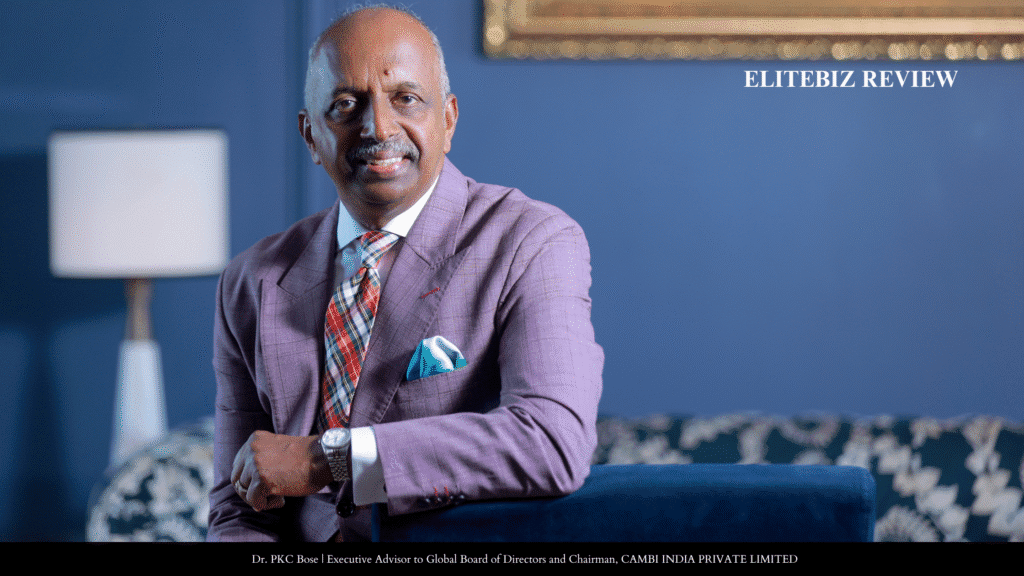
In an era defined by environmental urgency and the quest for regenerative growth, few leaders embody the principles of sustainability as profoundly as Dr. PKC Bose, Executive Advisor to Global Board of Directors and Chairman, CAMBI INDIA PRIVATE LIMITED. A visionary industrialist and global sustainability advocate, Dr. Bose’s leadership journey reflects a career-long dedication to one purpose: transforming industries and mindsets toward a circular, sustainable, and inclusive future.
From shaping multinational manufacturing empires to leading the charge in renewable energy, biogas, and waste-to-resource technologies, Dr. Bose’s professional story is one of innovation, integrity, and impact. Today, at the helm of Cambi India—part of the Norway-based global leader in sludge-to-biogas and biofertilizer technology—he stands as a driving force behind India’s transition to a circular economy. His mission: to prove that sustainability and prosperity are not opposing goals, but powerful partners in redefining the future of human progress.
A Career Built on Vision and Transformation
Dr. Bose’s journey toward becoming one of the world’s most respected sustainability leaders began with a simple yet profound conviction—to work only for organizations that serve the planet. His professional ascent is marked by leadership roles that span continents, technologies, and industries, each contributing to his deep understanding of industrial transformation and sustainable growth.
He began his career as General Manager of Operations for a U.S.-based company, where he developed a strong foundation in engineering management and operations excellence. His career soon took him to SEW EURODRIVE Group, a renowned German power transmission company, where he served as Managing Director & CEO for 12 years. Under his leadership, SEW EURODRIVE established a strong manufacturing presence in India and became a trusted name across the continent.
Later, Dr. Bose joined SAERTEX Group, Germany—the global leader in advanced technical textiles made from glass, carbon, and aramid fibers. For over 16 years, he steered SAERTEX’s Indian operations to the forefront of the composite materials sector, building one of the strongest organizations in the industry.
His next chapter took him to ENERCON Group, Germany, the world’s largest privately-owned wind turbine manufacturer, as Vice Chairman & Managing Director. There, Dr. Bose led a remarkable transformation of the company’s Indian operations. He established a world-class Innovation Centre, three manufacturing plants for wind turbine blades, generators, and towers, and positioned ENERCON India as a major global exporter of renewable-energy components. Under his stewardship, ENERCON became synonymous with engineering excellence, sustainability, and industrial innovation.
After completing his tenure at ENERCON, Dr. Bose co-founded ENREGO ENERGY GmbH, Germany, alongside senior colleagues from the ENERCON Group. ENREGO ENERGY focuses on wind, solar, green hydrogen, and energy storage systems—and has rapidly emerged as one of the fastest-growing green energy companies in Europe. In parallel, Dr. Bose has continued to serve as an advisor and board member to numerous international organizations leading the global sustainability transition, including ArcelorMittal Building Solutions, 2G Energy AG, Nagarro Group, EJOT GmbH, B&T Composite, and Kineco Composite.
Yet among his many roles, his work with Cambi Group holds a special place. As Executive Advisor and Chairman of Cambi India, Dr. Bose is bringing one of the world’s most transformative technologies—the Thermal Hydrolysis Process (THP)—to India for the first time, helping the country turn urban waste challenges into renewable energy opportunities.
Cambi India: Turning Waste into Wealth
Cambi Group, headquartered in Norway and listed on the Oslo Stock Exchange, is a global leader in sustainable wastewater treatment and resource recovery. Through its cutting-edge THP technology, the company transforms sewage sludge into biogas, biofertilizer, and clean water, enabling a full-circle solution for waste management.
Cambi India, under Dr. Bose’s leadership, is driving this mission forward by localizing and scaling the technology for India’s unique environmental and infrastructural needs. Its approach is not merely technological—it is transformational.
Cambi’s THP systems use high temperature and pressure to pre-treat sludge, breaking down organic material and significantly enhancing biogas yield. The process not only reduces sludge volume and operational costs but also produces pathogen-free, Class-A biosolids safe for agricultural use. As a result, wastewater treatment plants transition from being cost centers to energy-positive facilities that generate renewable power and valuable soil nutrients.
This innovation directly supports India’s broader sustainability objectives, from Net Zero 2070 to Swachh Bharat Urban 2.0, GOBAR-Dhan, and the National Green Hydrogen Mission. By enabling cities to generate renewable biogas and high-quality biofertilizer, Cambi India is contributing to cleaner energy, circular resource use, and sustainable agriculture—all crucial pillars of the circular economy.
“Cambi India is not just treating wastewater—it is reimagining waste as a resource,” says Dr. Bose. “Our mission is to turn sanitation challenges into economic opportunities and position India as a global leader in sustainable innovation.”
Evangelizing the Circular Economy
For Dr. Bose, being an evangelist for the circular economy is not simply a professional responsibility—it is a personal philosophy. He believes that circularity represents a transformative shift in how societies view waste, resources, and growth.
“To be a circular-economy evangelist is to challenge the take-make-dispose mindset and replace it with one of regeneration and renewal,” he explains. “It means proving that environmental stewardship can drive prosperity, and that sustainable growth is not a contradiction but a necessity.”
Dr. Bose drives this vision by bridging the gap between innovation and implementation. He works closely with utilities, policymakers, and industries to advocate for technologies that turn waste into value—anaerobic digestion, thermal hydrolysis, and biogas-to-energy systems among them. Through his mentorship and leadership, he not only guides decision-makers but also inspires the next generation of engineers, scientists, and entrepreneurs to see sustainability as the defining challenge of their time.
“Being a sustainability evangelist,” he says, “is about creating believers, not just customers; building systems change, not just projects.”
Innovation as the Engine of Climate Action
The cornerstone of Cambi’s success lies in innovation. The company’s THP technology transforms what was once an environmental liability—sewage sludge—into a renewable asset. Traditionally, sludge disposal has relied on landfilling or incineration, both costly and environmentally harmful. Cambi’s approach flips that paradigm, enabling cities to generate energy, improve soil health, and reduce emissions simultaneously.
“Cambi’s innovation demonstrates that sustainability and profitability can coexist,” Dr. Bose emphasizes. “Through biogas and biosolids production, we’re reducing methane emissions, supporting green hydrogen pathways, and cutting dependence on chemical fertilizers—all while creating local jobs and cleaner cities.”
Beyond technology, Dr. Bose views innovation as a mindset. It is about rethinking the purpose of infrastructure, redefining the value of waste, and reshaping the economy into a self-sustaining loop of regeneration. “Innovation is not only about inventing new tools,” he explains. “It’s about inventing new ways of thinking.”
Bridging Global Goals with Local Realities
India’s sustainability landscape presents a unique blend of challenges and opportunities. With rapid urbanization, population density, and diverse climatic conditions, the nation’s environmental strategy must balance global frameworks with local realities.
“India cannot simply copy Western sustainability models,” Dr. Bose notes. “We must build solutions that are scalable, affordable, and locally relevant.”
Cambi India’s work exemplifies this philosophy. By combining advanced European technology with localized design and execution, it creates systems that suit India’s infrastructure and economy. The company promotes decentralized treatment solutions for smaller towns alongside centralized systems for metropolitan areas, ensuring flexibility and inclusivity.
Equally important, Dr. Bose emphasizes the human dimension of sustainability. “Circular economy transformation must uplift people,” he says. “We cannot achieve environmental progress without social equity.” He advocates for integrating India’s informal waste workforce into formal recycling and resource recovery systems, ensuring safety, dignity, and opportunity for all.
Dr. Bose also stresses the role of innovation financing—green bonds, blended finance, and performance-based partnerships—to scale circular solutions. With clear policies, strong governance, and inclusive growth models, he believes India can lead the Global South in circular economy innovation.
Leadership for a Regenerative Future
Asked what defines an effective sustainability leader, Dr. Bose offers a simple yet profound answer: “Courage, empathy, and conviction.”
For him, leadership in the circular economy demands more than technical expertise—it requires moral clarity, cross-disciplinary collaboration, and the courage to challenge outdated systems. “True leaders,” he says, “see waste as opportunity, failure as feedback, and sustainability as the foundation of progress.”
He believes today’s leaders must be skilled storytellers—able to translate complex technical concepts into narratives that inspire people and influence policy. Equally, they must lead by example, embedding sustainability into every organizational decision, from operations to supply chain management.
“A leader’s role is to create believers in change,” Dr. Bose adds. “Sustainability leadership is not a title—it’s a commitment to stewardship of the planet and its people.”
Challenges and Opportunities Ahead
Promoting circular economy adoption is not without obstacles. Dr. Bose identifies several systemic barriers: entrenched linear business models, financing gaps, evolving regulatory frameworks, and fragmented coordination between public and private stakeholders.
“Changing mindsets is the hardest part,” he admits. “For decades, industries have viewed waste as a problem, not a resource. It takes time and education to reverse that.”
However, he sees tremendous growth potential in overcoming these barriers. As climate action accelerates and governments prioritize renewable energy and waste-to-resource projects, technologies like Cambi’s are gaining unprecedented momentum.
“India’s focus on bio-CNG, biomethane, and green hydrogen creates an extraordinary opportunity,” Dr. Bose explains. “Circular solutions will no longer be niche—they will become national infrastructure.”
He envisions integrated ecosystems where waste, energy, and agriculture form interconnected systems—powering climate-smart cities, green industries, and resilient communities. “Circularity is not a concept of the future,” he emphasizes. “It is the foundation of the next economy.”
Collaborating for a Circular India
Dr. Bose views collaboration as the cornerstone of circular transformation. “No single organization can achieve sustainability alone,” he says. “Governments, municipalities, and private enterprises must work together to build ecosystems that make circularity viable and scalable.”
Cambi India embodies this philosophy through partnerships with utilities, government agencies, and industrial players. By co-designing projects, sharing knowledge, and building local capacity, the company ensures long-term success and community engagement.
To accelerate adoption, Dr. Bose advocates for forward-looking policies that standardize biosolids quality, promote energy-positive wastewater treatment, and incentivize biomethane and bio-CNG production. He also calls for integrated national frameworks that align missions like Swachh Bharat, GOBAR-Dhan, and the National Green Hydrogen Mission, enabling synergy between sanitation, energy, and climate programs.
“Circular transformation is a national partnership project,” Dr. Bose asserts. “When public purpose and private innovation align, progress becomes unstoppable.”
Shaping the Future: Cambi India’s Roadmap
Looking ahead, Cambi India’s roadmap reflects a blend of technological leadership and national purpose. The company aims to expand thermal hydrolysis adoption across India, enabling cities to transform wastewater plants into energy-positive resource recovery centers.
It also plans to deepen its engagement in biogas, supporting India’s clean-energy ambitions through the production and utilization of renewable gases derived from sludge.
Local capacity building remains another priority. Cambi India is establishing partnerships with research institutions, engineering organizations, and training centers to develop skilled professionals in circular technologies. These initiatives will strengthen India’s self-reliance and global competitiveness in sustainability innovation.
Furthermore, the company is exploring opportunities in investing in digital performance monitoring, leveraging data analytics, IoT, and AI to optimize plant efficiency, ensure biosolids quality, and track emissions reductions. By combining engineering excellence with digital intelligence, Cambi India is setting new benchmarks for transparency and accountability in sanitation.
Finally, the company is working on projects that promote circular agronomy—using biosolids to restore soil health and reduce dependence on synthetic fertilizers. Through farmer partnerships, demonstration programs, and scientific certification, Cambi India is creating a regenerative agriculture model that completes the loop of the circular economy.
Inspiring the Next Generation
For Dr. Bose, sustainability is not just a professional pursuit—it is a legacy. His message to the next generation of leaders is both inspiring and urgent.
“You are the architects of a new civilization—one where prosperity and planetary health rise together,” he says. “Do not be intimidated by the challenges of our time. See them as invitations to innovate, collaborate, and redefine what progress means.”
He urges young professionals to view sustainability not as a trend but as a responsibility that spans technology, policy, ethics, and empathy. “The circular economy is not just about recycling materials—it is about recycling opportunity and re-engineering hope,” he says.
Dr. Bose believes that the future will belong to those who dare to imagine differently—to those who see the impossible as inevitable and commit to creating systems that serve both people and planet. “Sustainability is not the fight of a decade—it is the legacy of a lifetime,” he reminds. “Your leadership is the bridge between a world that survives and a world that thrives.”
A Legacy of Purpose
Across his multifaceted career, Dr. PKC Bose has remained unwavering in his mission: to champion technologies and partnerships that protect the Earth while powering progress. From renewable energy to wastewater transformation, his leadership is characterized by clarity of vision and depth of purpose.
In Cambi India, he has found the perfect platform to translate that purpose into tangible impact—helping India and the world transition toward a truly circular economy. His work exemplifies the power of global collaboration, local innovation, and moral leadership in building a regenerative future.
As the world races against time to balance growth with environmental responsibility, Dr. Bose’s voice resonates with wisdom and hope. He stands not just as a business leader or advisor but as a true Global Sustainability Evangelist—a visionary proving that the path to prosperity lies in harmony with the planet.