
Global supply chains are no longer measured solely by how efficiently products move from one point to another. Over the past several years, the conversation around logistics and supply chain management has fundamentally changed. Disruptions, geopolitical uncertainty, shifting customer expectations, digital acceleration, and sustainability pressures have exposed the limitations of traditional operating models that relied heavily on isolated planning and transactional relationships. In their place, a different philosophy is emerging-one where supply chains are increasingly viewed as interconnected ecosystems built on visibility, shared accountability, and coordinated decision making.
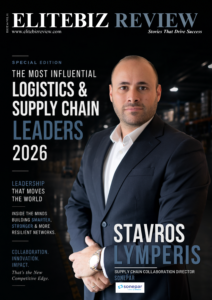
For organizations operating at global scale, this evolution is not optional. It is becoming essential to maintaining service reliability, managing volatility, and meeting rising expectations around responsiveness and customer experience. The companies succeeding in this environment are those capable of building deeper forms of alignment across suppliers, planners, distributors, and operational partners while leveraging technology to create faster, smarter, and more synchronized networks. That shift sits at the center of Stavros Lymperis’s leadership approach.
As a senior leader driving supply chain collaboration initiatives within Sonepar, the world leader in B2B distribution of electrical equipment, solutions, and services, Stavros operates in an environment where supply chain performance directly shapes customer experience across multiple markets and industries. With operations spanning 40 countries and a dense network of brands, Sonepar’s ongoing transformation toward a more connected omnichannel model requires coordination at a scale and level of sophistication that continues to reshape how modern supply chain ecosystems function.
At the core of that transformation is a broader philosophy that Stavros has consistently championed throughout his work: supply chains perform best when organizations stop treating alignment as a transactional exercise and begin treating it as a strategic capability.
His perspective reflects a growing reality across global logistics networks. Competitive advantage increasingly comes not from the strength of individual functions operating independently, but from how effectively entire ecosystems align around shared goals, shared visibility, and shared outcomes.
Moving Beyond Transactional Supply Chains
For decades, many supply chains operated through fragmented structures where each participant focused primarily on optimizing its own portion of the network. Manufacturers, distributors, suppliers, and logistics providers often worked within separate operational silos, sharing only the information necessary to complete immediate transactions.
That approach is becoming increasingly unsustainable in modern global markets.
Stavros believes supply chains achieve their strongest performance when organizations stop viewing the network as disconnected nodes and begin managing it as an integrated ecosystem.
“I have always believed supply chains perform best when they are managed as ecosystems, not as disconnected transactions.”
This distinction fundamentally changes how organizations work together. In transactional environments, relationships are often reactive and short-term, centered around resolving immediate operational requirements. In collaborative ecosystems, however, organizations focus on improving the end-to-end value chain together.
That requires a much deeper level of alignment. Shared objectives, common governance structures, performance visibility, and data-driven decision making become critical components of the operating model. Trust plays an important role, but Stavros emphasizes that trust alone is not enough. Sustainable alignment also requires discipline, structure, and accountability.
Within Sonepar’s broader supplier engagement agenda, this philosophy is closely tied to improving availability, reducing volatility, and creating a more consistent omnichannel experience for customers. Rather than treating suppliers as external contributors operating independently, the objective is to create integrated ways of working that improve performance across the entire network.
Why Collaboration Has Become a Strategic Capability
One of the recurring misconceptions in supply chain management is that collaboration simply means maintaining good relationships or exchanging information more openly. Stavros sees it very differently. For him, effective collaboration means creating outcomes collectively that individual participants could not achieve independently. It involves synchronized execution, aligned incentives, joint planning, and shared accountability.
The difference between organizations that genuinely work together and those that merely coordinate often becomes visible in how deeply these practices are embedded within the business itself. “What distinguishes truly collaborative organizations is that collaboration is treated as a strategic capability, not an initiative.”
That distinction is increasingly important as supply chains grow more interconnected and customer expectations continue to rise. Companies can no longer rely on isolated optimization within individual functions if the broader network remains misaligned. Instead, integrated working models must become operationally embedded within planning processes, governance structures, and digital systems.
In practice, this means organizations move beyond periodic coordination toward true co-creation. Shared KPIs, integrated planning routines, and common accountability frameworks create a structure where alignment becomes scalable rather than dependent on individual relationships alone.
This shift is also transforming how businesses think about competitive advantage. Increasingly, performance is determined not only by internal efficiency, but by how effectively organizations align the broader ecosystem around customer outcomes.
Managing Complexity Across Global Networks
Modern supply chains involve an extraordinary number of stakeholders, each operating with different priorities, incentives, and operational pressures. Aligning those interests across global environments requires more than process management. It requires leadership capable of creating common direction without eliminating operational diversity.
According to Stavros, alignment is not about forcing consensus across every stakeholder. Instead, it begins by anchoring organizations around shared value drivers.
“Complexity is a reality in global supply chains, and alignment does not come from eliminating differing priorities-it comes from aligning around shared outcomes.”
Service reliability, operational efficiency, resilience, and sustainability become common points of alignment even when individual organizations maintain different internal priorities. Once those shared ambitions are established, governance structures and structured dialogue help manage the inevitable differences that emerge across complex networks.
This approach recognizes an important reality of modern logistics ecosystems: diversity of perspective is unavoidable. The objective is not to eliminate complexity, but to create frameworks where diverse stakeholders can contribute toward common outcomes while maintaining operational flexibility.
Building Trust Through Transparency and Accountability
Trust remains one of the most important-and often misunderstood-elements within supply chain ecosystems. Many organizations assume visibility alone creates stronger partnerships. Stavros argues that transparency only becomes meaningful when paired with accountability and shared problem-solving.
“Visibility alone does not create trust; what matters is what partners do with that visibility.”
The strongest partnerships are not necessarily those without operational issues or disruptions. They are the ones where challenges are addressed collectively rather than pushed across organizational boundaries.
Open data sharing, joint performance reviews, and structured governance models create clarity around expectations and responsibilities. That clarity, in turn, strengthens trust because organizations understand not only what information is being shared, but how decisions will be made based on that information.
Formal operating models also play an increasingly important role in scaling these relationships. By defining decision rights, governance routines, and accountability mechanisms, organizations reduce ambiguity and create consistency across partnerships.
For Stavros, trust grows through repeated operational behavior rather than rhetoric. When integrated working models become structured, measurable, and value-driven, stronger relationships naturally follow.
The Shift Toward Predictive Supply Chains
Digital transformation is rapidly changing how supply chains operate, particularly in large-scale distribution environments where speed, visibility, and responsiveness directly influence customer experience.
At Sonepar, digital transformation is closely connected to the company’s broader ambition of delivering a seamless omnichannel experience. Achieving that requires far more connected and data-driven ways of working across supplier ecosystems. Stavros describes this evolution as a shift from reactive coordination toward predictive orchestration.
Shared data platforms, analytics capabilities, automation, and digital integration are enabling supply chains to operate with greater speed and precision while responding to real-time signals in ways that were previously impossible.
One of the most significant developments is the transition from periodic planning cycles toward continuous, exception-based coordination. Rather than waiting for scheduled reviews to identify issues, organizations can now monitor shortages, delays, and demand fluctuations continuously through shared dashboards and control tower capabilities.
Automation increasingly supports this process by triggering recommended actions before disruptions materially affect service performance. Artificial intelligence further enhances these capabilities by improving forecasting accuracy, identifying anomalies, and highlighting decisions requiring cross-company alignment.
Importantly, Stavros does not position digital transformation purely as a tool for efficiency. Its greater value lies in enabling entirely new forms of alignment where organizations can jointly manage risk, optimize network decisions, and improve responsiveness across the ecosystem.
Resilience as a Designed Capability
The disruptions experienced across global supply chains in recent years have fundamentally changed how organizations think about resilience. Reactive crisis management is no longer sufficient in environments where volatility has become persistent rather than exceptional.
For Stavros, one lesson has become particularly clear: “Resilience is designed, not improvised.” Modern risk management increasingly depends on building flexibility, visibility, and optionality directly into the operating model. Strong supplier partnerships and shared planning processes become critical components of that resilience framework.
Organizations capable of sharing scenarios, coordinating responses, and making integrated decisions are often far better positioned to absorb disruption without amplifying operational instability across the network.
This perspective reflects a broader shift in supply chain thinking. Working closely across ecosystems is no longer viewed solely as an efficiency mechanism. Increasingly, it functions as a resilience capability that strengthens adaptability during periods of uncertainty.
Data as the Common Language of Supply Chains
As supply chains become more connected, data has emerged as one of the most important enablers of aligned decision making. Without trusted and shared information, organizations often become dependent on assumptions, conflicting interpretations, or negotiation-driven outcomes.
For Stavros, data creates a common language across the ecosystem. “With shared data and aligned performance metrics, partners can make fact-based decisions together and focus discussions on value rather than interpretation.”
This shift allows organizations to move conversations away from debating operational realities and toward improving outcomes collectively. Shared metrics create alignment, while faster access to information enables more responsive decision making across functions and partners.
However, Stavros is careful to distinguish between possessing data and creating value from it. The true advantage emerges when data enables organizations to make smarter trade-offs, respond more quickly, and coordinate decisions across the network.
That is where integrated supply chain ecosystems begin to move beyond operational coordination and become a source of competitive strength.
Designing Supply Chains Around the Customer
Despite the increasing complexity of logistics networks, Stavros consistently returns to one central principle: all operational alignment ultimately matters because of its impact on the customer. “For a customer-centric organization like Sonepar, the ultimate test of supplier collaboration is whether it measurably improves customer satisfaction.”
Availability, responsiveness, reliability, and service quality remain the true indicators of supply chain effectiveness. Alignment, therefore, should not become an objective in itself. It must translate into measurable improvements in customer outcomes.
Achieving this requires organizations to move beyond optimizing isolated internal functions. Vendors, planners, and operational teams must align around customer impact rather than departmental priorities.
In the highest-performing supply chains, customer value becomes the common denominator connecting every operational initiative across the ecosystem.
Leadership in Collaborative Supply Chains
Leading large-scale supply chain ecosystems requires a leadership style that differs significantly from traditional command-and-control models.
Technical expertise remains important, but Stavros believes the most effective leaders also possess curiosity, systems thinking, and the ability to build trust across diverse stakeholder groups.
“Collaboration and innovation rarely happen through command and control-they happen through leadership that enables others to contribute.”
This mindset becomes increasingly important in environments where innovation often emerges across organizational boundaries rather than within isolated teams. Leaders must simplify complexity, create alignment, and foster environments where new ideas and stronger partnerships can scale naturally.
Balancing strategic direction with operational discipline is equally essential. Strong ecosystem management requires both vision and execution, particularly in environments involving multiple organizations operating across different priorities and markets.
Turning Strategy into Measurable Business Impact
Within Sonepar’s supplier engagement program, Stavros identifies several use cases that are particularly critical for transforming strategic alignment into tangible operational and customer outcomes.
Joint demand and supply planning remains one of the most important. By integrating suppliers more directly into forecasting and replenishment decisions, organizations create a more aligned and forward-looking view of demand and inventory.
End-to-end value chain optimization is another major focus area. Rather than improving isolated operational segments independently, organizations work together to redesign flows, reduce structural costs, and improve efficiency across the broader network.
Inventory and availability optimization has also become increasingly important as businesses attempt to balance service expectations with resilience and inventory efficiency. Shared visibility and digital integration allow organizations to improve service levels while reducing unnecessary inventory exposure across the network.
Success, however, is measured through customer-centric KPIs. Service level performance, lead-time adherence, and on-time in-full delivery remain essential metrics because they create a common operational language across partners while keeping efforts focused on customer outcomes.
When these metrics improve consistently through shared data, governance, and digital integration, ecosystem alignment evolves from a conceptual initiative into a scalable operational capability.
The Operating Model Behind Scalable Ecosystems
For integrated supply chain ecosystems to scale effectively, Stavros believes operating models must remain explicit, disciplined, and consistent without becoming unnecessarily complicated. That foundation begins with aligned definitions, shared metrics, and clear decision rights regarding what is managed jointly versus locally. Structured operating routines-from weekly operational reviews to quarterly business alignment discussions-help maintain consistency across the ecosystem. Clear ownership on both sides of the partnership is equally critical. Without accountability, alignment often becomes discussion without execution.
Interestingly, Stavros notes that the biggest barriers to scalable ecosystems are rarely technological. More often, challenges stem from silo behavior, unclear accountability, and misaligned incentives that encourage organizations to push problems elsewhere rather than solve them collectively. Consistency ultimately becomes the differentiator. Governance, follow-through, and aligned priorities gradually transform trust from an aspiration into a natural operational outcome.
Preparing for the Next Era of Supply Chain Ecosystems
Looking ahead to 2026 and beyond, Stavros sees supply chain ecosystems evolving in several important directions. Digital integration and AI-driven planning will continue enabling more predictive and increasingly autonomous forms of coordination. Supply chains will operate less like linear transactional structures and more like interconnected ecosystems built around deeper strategic partnerships.
At the same time, resilience and sustainability will become embedded directly within operational decision making rather than treated as separate initiatives. Supply chain alignment itself will become increasingly data-driven, performance-based, and supported by common digital platforms and shared KPIs. Most importantly, ecosystem-based supply chain management will increasingly be recognized not simply as an operational capability, but as a strategic growth lever capable of shaping long-term competitive advantage.
The organizations that stay ahead, Stavros believes, will be those willing to invest early in integrated operating models, digital foundations, and ecosystem partnerships. In the years ahead, the supply chains that create the greatest advantage will not simply be the fastest or the largest, but the ones most capable of aligning entire ecosystems around shared value.