
The Unconventional Beginning That Redefined Perspective
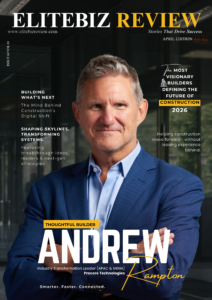
Some careers follow a predictable trajectory – education, specialization, and steady advancement within a defined discipline. Others, however, are forged in environments so intense and exacting that they fundamentally reshape how an individual interprets systems, people, and progress itself. Andy Rampton’s journey belongs firmly in the latter category. Today, as Industry Transformation Leader for APAC & MENA at Procore Technologies, he brings that distinct perspective to an industry undergoing profound change.
Before stepping into the construction industry, Andy began his professional life in the highly complex world of nuclear weapons engineering – an arena where precision is absolute and the consequences of failure extend far beyond immediate outcomes. In such a domain, there is no tolerance for ambiguity, no room for miscommunication, and certainly no margin for error.
Yet, beyond the technical rigor, what left the most enduring impression on Andy was not simply the systems themselves, but how people interacted within them. He observed that human behavior, communication protocols, and process discipline were just as critical as the technology in ensuring success. This early exposure instilled in him a philosophy that would later define his approach to construction: technology, no matter how advanced, is only as effective as the human systems that govern and operate it.
When Andy transitioned into construction, he carried with him a perspective that allowed him to see beyond accepted norms. Where others saw fragmentation as inevitable, he identified opportunities for cohesion. Where inefficiencies were tolerated as part of the process, he recognized the potential for transformation.
A Defining Moment: The London Olympics and the Power of Collaboration
Andy’s introduction to the future of construction – driven by technology and data – coincided with one of the most ambitious and closely scrutinized global projects of the modern era: the London Olympics. It was here, in 2009, that he encountered a technology that would profoundly influence his thinking: Building Information Modeling (BIM).
At the time, BIM was widely perceived as an advanced visualization tool – a sophisticated way to create detailed three-dimensional representations of buildings. But Andy saw something far more transformative beneath the surface. To him, BIM represented a fundamental shift in how teams could collaborate.
Traditional construction workflows had long been linear – information passed sequentially between stakeholders, often leading to delays, misinterpretations, and costly rework. BIM introduced the possibility of a shared digital environment, where all stakeholders could engage simultaneously, align in real time, and make informed decisions collectively. It transformed collaboration from a fragmented, reactive process into an integrated and proactive experience.
This realization marked a turning point. Andy began to see technology not as a supplementary tool, but as the connective tissue capable of unifying the entire construction ecosystem. Over time, this perspective evolved even further. Construction, he came to understand, was no longer simply about delivering projects – it was about building intelligent, data-driven environments that enable continuous improvement, adaptability, and innovation.
From Digitization to Intelligence: The Rise of a Data-Driven Industry
For decades, the construction industry has been defined by manual processes and fragmented systems of information. While digital tools have been introduced over time, their impact has often been constrained by a lack of integration and interoperability. Today, however, the industry is undergoing a profound transformation – one driven by the realization that data is its most valuable and underutilized asset.
Every construction project generates vast amounts of data – ranging from safety observations and workforce productivity metrics to cost tracking and supply chain performance. Historically, much of this data remained siloed, archived rather than activated, and rarely used to inform forward-looking decisions.
Andy identifies the current moment as a critical shift – from data accumulation to data activation.
With the emergence of predictive analytics and agentic AI, construction is moving away from reactive reporting toward proactive orchestration. Instead of analyzing what went wrong last week, teams can now anticipate risks before they materialize. Safety hazards can be identified before incidents occur. Budget deviations can be flagged before they escalate. Scheduling conflicts can be resolved before they disrupt progress.
What once seemed aspirational is rapidly becoming operational reality.
Andy often describes this evolution as the introduction of a “digital crew member” – an intelligent layer within technology platforms that works alongside human teams. This digital counterpart enhances decision-making, removes friction from workflows, and transforms how projects are managed at scale.
Importantly, this shift is not just about efficiency – it is about empowerment. By eliminating the burden of manual data processing and administrative tasks, professionals are freed to focus on higher-value activities: innovation, creativity, and strategic problem-solving.
Operating at the Epicenter of Global Transformation
In his role as Industry Transformation Leader for APAC and MENA at Procore Technologies, Andy operates across regions that are redefining the boundaries of the built environment. These markets are characterized by bold ambition, rapid urbanization, and a willingness to embrace cutting-edge innovation.
From next-generation smart cities to large-scale infrastructure developments, these regions are pushing the limits of what is possible in construction.
One of the most significant trends Andy observes is the unprecedented pace of AI adoption. Organizations are integrating advanced technologies at a rate that surpasses any previous innovation cycle. However, this rapid acceleration also exposes a critical challenge – what Andy refers to as the “data tax.”
While large enterprises are equipped to leverage sophisticated AI-driven solutions, many smaller firms – integral to the construction supply chain – continue to struggle with foundational digital processes such as documentation management, reporting, and workflow standardization. This disparity risks creating a fragmented industry where innovation benefits only a select few.
Yet, Andy remains optimistic.
He believes that the same technologies driving this transformation can also serve as equalizers – automating foundational processes, simplifying workflows, and making advanced capabilities accessible to organizations of all sizes. In doing so, the industry can move toward a more inclusive, connected, and cohesive future.
Transforming Resistance into Opportunity
Resistance to change has long been a defining characteristic of the construction industry. But Andy approaches this challenge with a deep sense of understanding. He recognizes that resistance is not rooted in unwillingness, but in a form of professional instinct – developed over decades of delivering complex projects under demanding conditions.
Traditional methods have endured because they work. They have built skylines, infrastructure, and communities across generations.
The key, therefore, is not disruption – but alignment.
Andy emphasizes the importance of empathy in driving transformation. Rather than positioning technology as a replacement, he advocates for what he calls “digital translation” – framing innovation in a way that aligns with existing objectives while removing inefficiencies.
By focusing on targeted use cases with clear and measurable outcomes, organizations can adopt technology incrementally, building confidence and momentum over time. This approach transforms digital adoption from a disruptive overhaul into a manageable and continuous evolution.
Equally critical is the recognition that digital transformation is not a one-time initiative. It is an ongoing journey – one that requires integration into the organization’s broader strategy, culture, and operational fabric. When done correctly, technology becomes invisible in the best possible way – seamlessly enhancing how teams work without altering the essence of what they do.
Redefining Collaboration Through a Shared Reality
In today’s construction landscape, collaboration is no longer optional – it is foundational. Projects now involve an increasingly complex network of stakeholders, each contributing specialized expertise and perspectives. Managing this complexity requires a level of transparency and communication that traditional systems struggle to provide.
Modern technology platforms address this challenge by creating a “single source of truth” – a unified environment where all project data is accessible in real time.
The impact of this is profound.
Operationally, it ensures that decisions are based on accurate, up-to-date information. When a subcontractor on-site has access to the same data as an executive in the boardroom, alignment improves dramatically, and costly miscommunications are minimized.
Culturally, the implications are equally significant. Construction has historically been an industry where conflict and blame are often embedded in project dynamics. By establishing a shared and transparent record of truth, technology reduces ambiguity and removes the need for finger-pointing. It shifts the focus from documenting problems to solving them collaboratively.
In this way, transparency becomes more than a technical capability – it becomes a driver of trust, alignment, and ultimately, better outcomes.
Sustainability as a Strategic Imperative
Sustainability has evolved from a peripheral consideration into a central pillar of construction strategy. Today, it is no longer sufficient to deliver projects efficiently – they must also be environmentally responsible and future-ready.
Andy sees technology as a critical enabler in achieving this transformation.
The journey begins in the design phase, where data-driven insights allow teams to make more informed decisions about materials, configurations, and lifecycle impacts. By understanding where materials originate, how they are produced, and how they perform over time, organizations can significantly reduce embodied carbon and eliminate unnecessary waste.
During construction, technologies such as digital twins enable precision execution. By simulating processes and monitoring performance in real time, teams can optimize resource utilization, reduce rework, and ensure that every action contributes to efficiency and sustainability.
The result is a shift from a traditionally waste-intensive process to one defined by precision, accountability, and environmental consciousness.
The Evolution of Leadership in a Digital Age
As the industry transforms, so too must its leaders. Andy envisions a new generation of construction leadership – one that seamlessly blends technical expertise with digital fluency.
Future leaders will not view technology as a separate function, but as an integral component of their decision-making process. They will be comfortable navigating data, leveraging insights, and adapting to continuous change.
Equally important is their ability to lead diverse, hybrid teams – bringing together experienced professionals, digitally native talent, and intelligent systems into a cohesive and collaborative environment.
Leadership, in this context, becomes less about control and more about enablement.
The most effective leaders will be those who can foster a culture of innovation, encourage experimentation, and empower individuals to contribute meaningfully. They will understand that the strength of a project lies not only in its design or execution, but in the collective intelligence of the people and systems behind it.
Innovation That Transforms Human Experience
Andy’s involvement in NEOM’s The LINE project in Saudi Arabia offers a compelling illustration of how technology can deliver tangible human impact.
While the project is widely recognized for its ambitious vision and advanced technological framework, one of its most meaningful innovations was deceptively simple – the automation of the design review process.
Traditionally, design reviews on projects of such scale involve numerous stakeholders and can take months to complete. By developing a system that could analyze consolidated BIM models and generate compliance reports automatically, the project team significantly accelerated this process.
But the true value of this innovation extended beyond time and cost savings.
By eliminating a labor-intensive and repetitive task, it allowed engineers and designers to redirect their focus toward more creative and fulfilling work. It transformed their experience – from one defined by administrative burden to one centered on innovation and problem-solving.
This is where technology delivers its greatest value – not by replacing people, but by enabling them to do their best work.
A Future Defined by Possibility
The construction industry stands at a defining inflection point – one where long-standing challenges converge with unprecedented technological opportunity. Workforce shortages, mental health concerns, and decades of stagnant productivity have created what many perceive as a crisis. For Andy, however, this moment represents something far more powerful: an opportunity for reinvention.
The coming decade will not be defined by incremental change, but by systemic transformation.
Construction sites will evolve into intelligent environments where human capability is augmented by robotics, automation, and advanced analytics. Physical strain will be reduced through exoskeletons and mechanized support systems, while safety will shift from reactive protocols to predictive certainty.
At the same time, breakthroughs in materials science will give rise to a new generation of adaptive, responsive structures – buildings that not only exist within their environments but actively contribute to them. From self-healing materials to carbon-sequestering systems, the built environment will become more dynamic, sustainable, and resilient.
Central to this transformation is the role of data. Construction will move from reactive problem-solving to proactive orchestration – where decisions are informed in real time, risks are anticipated, and outcomes are engineered with precision.
Yet, the most meaningful transformation lies in what this enables for people.
By automating repetitive tasks and eliminating inefficiencies, technology creates what Andy describes as “time wealth” – freeing professionals to focus on creativity, innovation, and strategic thinking. This shift has the potential to redefine the experience of working in construction, making it more engaging, fulfilling, and purpose-driven.
A Legacy That Extends Beyond Structures
At its core, construction extends far beyond the act of building – it is about shaping the world in which future generations will live, work, and connect.
Every project contributes to a broader narrative. It influences communities, economies, and environments in ways that endure long after completion. This perspective brings with it both responsibility and opportunity.
Today’s leaders are not simply delivering projects – they are making decisions that will define the sustainability, resilience, and livability of the future. Andy believes that this responsibility should be embraced as an opportunity to elevate the industry – balancing efficiency with sustainability, innovation with inclusivity, and progress with purpose.
The future will belong to leaders who can bridge the gap between tradition and transformation – those who respect the wisdom of experience while embracing the possibilities of technology.
Shaping the Next Chapter of Construction
Andy Rampton’s journey reflects a clear belief: construction’s future will be shaped not just by technology, but by the people who choose to lead with it. As he puts it, “You are not just builders of physical objects – you are the architects of a sustainable global legacy.” The infrastructure created today will outlive its makers by decades, making it critical that what is built is worthy of that longevity.
But Andy is equally clear that progress doesn’t start with grand visions alone. It begins with getting the fundamentals right – “the boring stuff” – from digitising materials tracking and safety logs to improving reporting. These foundations, once automated, create what he describes as “time-wealthy” teams – free to focus on creativity, innovation, and higher-value work. At the same time, he highlights a defining shift in the industry. The future isn’t about replacing experience, but integrating it. The “old guard,” with decades of site-proven knowledge, remains essential. Real progress lies in bridging this generational divide – blending digital capability with practical wisdom to deliver better outcomes.
Ultimately, Andy’s message to the next generation is grounded yet ambitious: lead change with empathy, respect the craft, and build with purpose. Because the opportunity ahead isn’t just to adopt new tools – but to redefine what the construction industry can become.