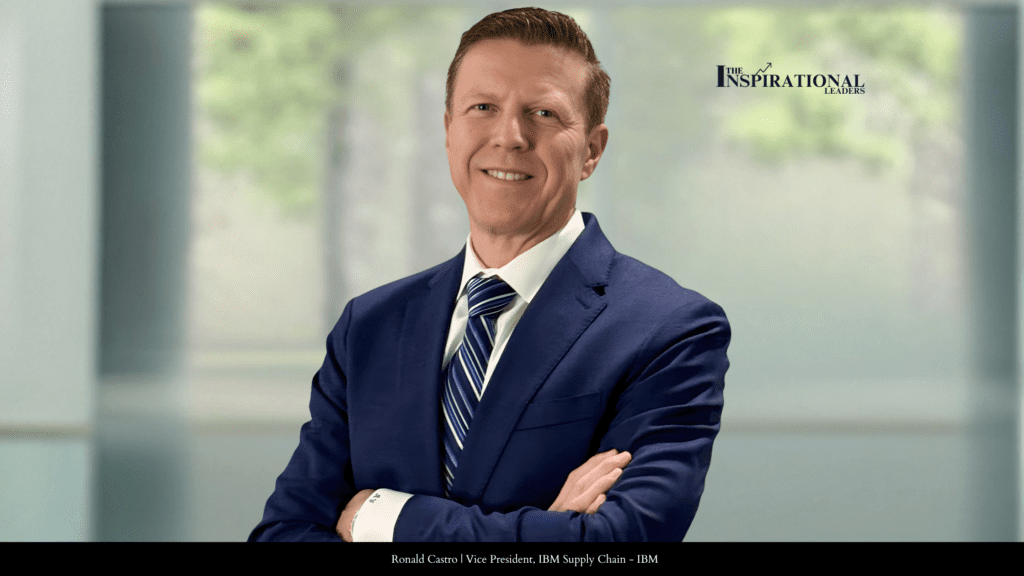
From San José, Costa Rica, to executive leadership within one of the world’s most respected technology organizations, Castro’s journey is not merely a story of professional advancement. It is a testament to adaptability, humility, and the courage to embrace unexpected opportunities.
In an era defined by global interdependence, operational complexity, and constant transformation, few leaders embody resilience and cross cultural stewardship as profoundly as Ronald Castro, Vice President of Supply Chain at IBM. Recognized in The Most Influential Latino Business Leaders 2026, Castro represents more than executive excellence. He represents the power of conviction, cultural identity, and long term vision in shaping global enterprise.
From Costa Rica to the World Stage
Born and raised in San José, Costa Rica, Castro’s early ambitions were grounded and practical. With determination and clarity of purpose, he left his home country to pursue engineering at Purdue University. His objective was simple yet meaningful: complete his undergraduate and graduate studies, return home, and eventually lead a manufacturing plant.
However, life often reshapes even the most carefully crafted plans. During his time at Purdue, an encounter with an IBM recruiter introduced him to a scale of opportunity he had never fully imagined. The possibility of working within a truly global organization expanded his perspective beyond national borders. Initially, he viewed the move as temporary. His intention was to gain multinational experience for a few years and then return to Costa Rica better prepared for leadership.
Yet once immersed in IBM’s global ecosystem, Castro discovered something transformative. The complexity of the challenges, the depth of collaboration across continents, and the tangible global impact of the work altered his trajectory. What was meant to be a short professional chapter evolved into a lifelong commitment.
“He recalls that when he initially joined the organization, he saw it as a brief professional experience rather than a place where he would build his entire career, expecting it to be a stepping stone rather than a permanent path. “However, the continuous opportunities to learn, strengthen my expertise, and contribute to work that makes a meaningful difference across global markets affirmed that this was where I was meant to build and advance my career.”
Early Lessons in Global Leadership
From the outset of his career, Castro found himself collaborating with teams that spanned multiple geographies. These early experiences were not simply operational exercises. They were leadership laboratories.
Driving change across borders required far more than technical execution. It demanded alignment across cultures, clarity of communication, and the ability to build trust among diverse stakeholders. Castro quickly realized that leadership effectiveness could not be confined by geography. It had to transcend it.
He intentionally sought roles that exposed him to different business functions and operating models. From line management to corporate strategy, from functional assignments to enterprise wide transformation initiatives, each step broadened his understanding of the end to end supply chain landscape.
Over time, this intentional openness became a defining strength. Castro lived and worked across multiple regions of the United States, from the West Coast to the East Coast and the South. Internationally, his professional journey took him to France, Brazil, Australia, and China. Each location offered new lessons in adaptability and cultural awareness.
“With every transition, my ability to lead with deeper understanding and cultural awareness continued to grow,” he shares. Experiencing diverse markets and leadership environments firsthand provides a level of understanding and perspective that cannot be fully gained through academic study or theoretical frameworks alone.
The Evolution of a Leadership Philosophy
Castro’s leadership style has evolved significantly over the course of his career. In his early years, he was intensely focused on technical mastery and operational excellence. He sought to understand every dimension of supply chain operations, building expertise across manufacturing, strategy, and transformation initiatives.
This foundation proved invaluable. It strengthened his business acumen and deepened his understanding of organizational dynamics. However, as his responsibilities expanded, so did his perspective on what leadership truly required.
Today, Castro describes his approach as purpose driven and collaborative. While operational rigor remains critical, his focus has shifted toward building strong organizational capabilities and cultivating culture. He believes that sustained success comes not only from delivering results but from empowering people.
Over the years, he has realized that true leadership is not about personal achievement, but about creating the conditions where others can grow, perform at their best, and succeed collectively. “It is about developing resilient and high performing teams, aligning everyone around a common purpose, and achieving outcomes that generate sustainable value for the entire organization.”
Mentorship and coaching have become central to his philosophy. Castro places significant emphasis on talent development, ensuring that individuals within his organization are equipped to grow, adapt, and thrive in evolving environments.
Driving Modernization with Clarity of Purpose
The modern supply chain environment is defined by volatility, interconnected ecosystems, and rising expectations from clients and partners. For Castro, transformation is not optional. It is imperative.
Under his leadership, IBM’s supply chain organization has pursued modernization guided by a clear North Star: delivering operational excellence, supporting clients, strengthening partnerships, and empowering a highly engaged workforce.
A platform based operating model has been adopted to enhance end to end connectivity. By integrating Artificial Intelligence and advanced tools into core processes, the organization has improved decision making, strengthened visibility across operations, and enhanced agility throughout the value chain.
Yet Castro emphasizes that structural transformation alone is insufficient. Cultural evolution is equally essential.
“He emphasizes that today’s supply chain environment demands strong collaboration across departments and an ongoing commitment to developing new skills to remain effective and competitive. Effective leadership requires the courage to adapt decisively and the clarity to guide others confidently through change.
To that end, investment in talent development has been prioritized. Teams are encouraged to expand their capabilities, deepen their expertise, and cultivate a mindset that embraces innovation and accountability. Resilience is also central to strategy, with strengthened risk management capabilities enabling faster response to disruptions.
Looking ahead, Castro envisions supply chains defined by predictive insight, transparency, and real time connectivity. For him, the supply chain is not merely an operational necessity. It is a strategic differentiator capable of driving long term competitive advantage.
The Influence of Cultural Identity
Being recognized among the most influential Latino business leaders of 2026 holds deep personal significance for Castro. His cultural background is not a footnote in his story. It is foundational.
Raised with a strong sense of family and community, he internalized the belief that success is collective rather than individual. Celebrating team achievements and sharing credit are natural extensions of this upbringing.
That mindset shapes his leadership approach. Long term relationships and shared purpose take precedence over short term victories. He evaluates performance not only by business outcomes but also by how those outcomes are achieved and the strength of the culture that emerges as a result.
Respect, humility, and hard work were non negotiable values in his upbringing. They remain constant guiding principles, whether he is engaging with senior executives or walking the factory floor.
Growing up navigating different cultural environments also taught Castro the power of listening. Diverse perspectives enrich decision making. Inclusion strengthens execution. Representation creates possibility.
“As a Latino leader in corporate leadership, visibility matters,” he says. “When individuals witness leaders who share similar backgrounds stepping into positions of influence, it broadens their belief in what they themselves can achieve.”
This awareness fuels his commitment to mentorship and sponsorship. He actively works to create access to opportunity for individuals from diverse backgrounds, understanding that inclusive leadership is not simply strategy. It is responsibility.
Lessons Forged Through Adversity
No leadership journey is complete without moments of profound challenge. For Castro, one of the most defining experiences of his career came through failure.
Approximately two decades ago, he stepped into his first executive role, leading transformation efforts for a demanding client within a complex environment. Simultaneously, his wife was expecting their first child, adding personal intensity to professional pressure.
The project was ambitious. Expectations were high. Despite years of success leading up to that point, Castro struggled in the role. Issues were not addressed promptly. Challenges compounded. What began as manageable obstacles escalated into larger problems.
When senior leadership intervened to assess the situation, Castro faced a critical choice: deflect blame or take accountability. He chose accountability.
He conducted a candid retrospective, identified leadership gaps, and fully embraced the lessons. The experience reshaped his approach to leadership. He learned the importance of assertiveness, urgency in addressing difficult issues, active listening, clear communication, expectation management, and seeking support when needed.
Rather than allowing the setback to define him, he allowed it to refine him. Shortly thereafter, another high stakes opportunity emerged. Castro was asked to lead a troubled initiative in Shanghai, again during a period when his wife was pregnant, this time with their youngest son. The circumstances were demanding. However, armed with the lessons from his earlier experience, he approached the assignment with renewed resolve.
The outcome was dramatically different. Organizational capabilities were strengthened. Processes improved. Local leadership developed. The supply chain was positioned to support business growth more effectively. The success of this initiative ultimately led to his promotion to Vice President, overseeing global manufacturing operations and strategy.
These experiences reinforced a fundamental truth for Castro: resilience, accountability, and continuous learning are the cornerstones of strong leadership.
Vision for the Future
As Castro looks ahead, he recognizes that the current era presents extraordinary opportunities to redefine what is possible within global operations.
His focus is clear: serve as a catalyst for transformation. Leverage artificial intelligence and digital technologies to strengthen IBM’s supply chain and help advance industry standards. Drive strategic impact at scale while continuing to evolve how organizations operate and create value.
However, his vision extends beyond systems and processes. It centers on people. Mentorship and talent development remain central priorities. The next generation of leaders must be inclusive, resilient, adaptable, and grounded in a global growth mindset. As business models continue to evolve, human centered leadership will matter more than ever.
“Castro shares that his ambition is to cultivate leaders who are equipped to face complexity with assurance, clarity, and the confidence to make thoughtful decisions even in demanding environments. “Leaders who can inspire teams, embrace change, and uphold integrity under pressure.”
In terms of legacy, he hopes to leave behind a modern, innovative supply chain organization recognized not only for performance but also for purpose. An organization characterized by ethical leadership, strategic foresight, and inclusive culture.
If he can help build an environment rooted in trust, transparency, and collaboration, one that consistently empowers individuals to reach their full potential, he will consider that a meaningful achievement.
Ultimately, Castro aspires to leave an organization energized and prepared for future challenges, confident in its people and united by shared purpose.
A Legacy of Collective Success
Ronald Castro’s journey from Costa Rica to global executive leadership is a story of vision expanded, lessons earned, and values preserved. It is a narrative defined not by shortcuts or sudden leaps, but by deliberate growth, humility in the face of failure, and steadfast commitment to people.
In a world that often celebrates individual accomplishment, Castro’s leadership stands as a reminder that enduring impact is collective. It is built through collaboration, strengthened by diversity, and sustained through integrity.
As one of the most influential Latino business leaders of 2026, he exemplifies what is possible when cultural heritage, professional discipline, and global perspective converge.
His story continues to unfold, but its foundation is clear: purpose beyond borders, leadership grounded in values, and a legacy defined by enabling others to rise.