Leading Business Magazine | EliteBiz Review

October 2025

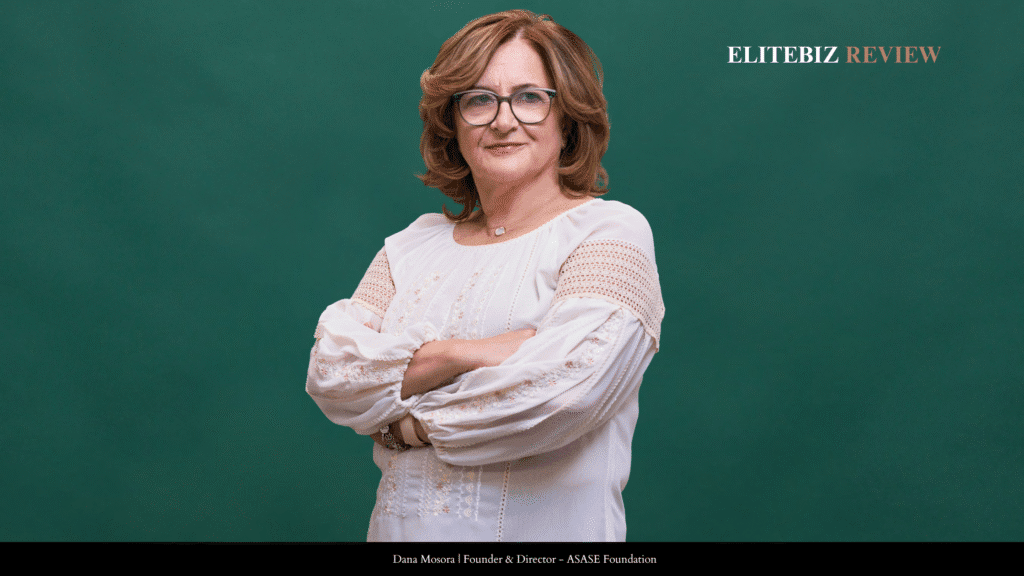
Dana Mosora | Founder & Director - ASASE Foundation

Trailblazing Sustainability: How Dana Mosora and the ASASE Foundation Are Turning Plastic Waste into Opportunity

Digital Version In an era where the conversation around sustainability often revolves around policy debates, corporate pledges, and technological breakthroughs, there remain stories of individuals who take a deeply personal journey to transform communities. One such story belongs to Dana Mosora, Founder and Director of the ASASE Foundation. Her work in Ghana is a testament to how vision, resilience, and community empowerment can redefine the future of plastic waste management while uplifting women and families in underserved regions. A Journey from Corporate Boardrooms to Community Streets Dana Mosora’s story begins far from Accra’s bustling markets or Kumasi’s neighborhoods. As a chemical engineer, she built her career with multinational companies like Colgate Palmolive, Sara Lee, and Dow Chemical. These roles afforded her global exposure, continuous personal growth, and the opportunity to learn from remarkable colleagues. Over the years, she gathered not just technical expertise, but a deep appreciation for how collective knowledge and mentorship shape a professional journey. Yet, as retirement approached, she found herself reflecting on the wealth of experiences she had accumulated. “I always felt that people with whom I worked and, from whom I learned so much through the years, left each their own mark and somehow made me a better and more accomplished professional,” Mosora recalls. With this realization came the desire to give back—to redirect her skills and energy towards a mission beyond corporate success. Her answer came during work travels in Africa, where she witnessed firsthand the pervasive absence of plastic waste management systems. The sight of discarded packaging flooding streets and waterways revealed a challenge she could no longer ignore. What began as a retirement hobby soon evolved into a life mission. Drawing inspiration from the resilience of women in African communities—women she observed leading families and villages with unmatched determination—Mosora envisioned an initiative that would tackle plastic waste while empowering women. With some of her early retirement funds and a $100,000 grant from the Dow Impact Fund, she established the ASASE Foundation in Accra, Ghana. The first imperfect but symbolic step was building a recycling plant for discarded water sachets—ubiquitous in Ghana’s communities yet devastating to the environment. This first step, though small, laid the foundation for what would grow into a model of hope for communities across the country. The Core Mission: Turning Waste into Value At its heart, the ASASE Foundation exists to demonstrate that community-driven solutions can tackle plastic waste while creating livelihoods. Its mission is clear: build and manage community-based recycling operations, empower women to lead them, and ultimately transfer ownership to local employees. The focus is on water sachets—small plastic packets of drinking water that dominate the Ghanaian market. While affordable, they contribute massively to street litter and clogged drains. The Foundation diverts these sachets from becoming pollution and instead recycles them into usable plastic, creating both cleaner streets and economic value. “We enable women to become key players in the solution,” Mosora explains. “We finance the infrastructure and manage operations until employees, majority women, are ready to take over.” The approach is holistic: job creation, skill development, community empowerment, and environmental restoration all converge. Today, ASASE’s operations support about 200 employees across three plants—two in Accra and one in Kumasi. The majority are women, who not only earn secure incomes but also gain leadership experience. In every sense, the Foundation embodies a model where waste becomes worth, and marginalized communities transform into pioneers of circular economy practices. One concrete materialization of the value created for the community is the conversion plant in Weija Gwabe, Accra , still in pilot phase, where plastic waste is transformed in plastic lumber used by local artisans to build outdoor furniture and school benches. Confronting the Obstacles in Sustainable Packaging To understand the urgency behind ASASE’s mission, one must consider the larger picture of sustainable packaging. For decades, the packaging industry innovated with a focus on performance, convenience, and cost efficiency. This resulted in increasingly complex packaging: multilayer composites of plastics, metals, and paper designed to maximize function—but virtually impossible to recycle. “It became really sophisticated without any consideration of the end of life,” Mosora observes. The consequence? Plastic packaging waste that accumulates globally, especially in regions with little to no waste infrastructure. The path forward, according to Mosora, requires bold redesign. Packaging must be simplified and built for recyclability. Innovations are underway, but economic barriers remain—chiefly the high cost of recycled plastic compared to virgin materials. Legislative interventions, like Europe’s Packaging and Packaging Waste Regulation, which mandates recycled content and recyclability at scale, are vital levers for change. However, in the Global South, where 80% of plastic packaging ends up as litter due to absent systems, the issue is even more urgent. Here, the challenge is twofold: building basic waste management infrastructure and financing it. While organizations like the Alliance to End Plastic Waste support many projects with the aim to create a systemic change, Mosora emphasizes that systemic solutions require much larger investments and new innovative financial support solutions. Without bold leadership, the cycle of waste and pollution persists. Advancing Circular Economy Practices in the Global South The ASASE Foundation serves as a living model of circular economy in action. By embedding recycling within communities, the Foundation ensures that value created from waste remains local. “It’s about cashing-in the plastic waste of the community for the benefit of the community,” says Mosora. In practice, this means plastic sachets collected from streets are processed into recycled materials, which can then be sold or repurposed. Local people gain jobs, new skills, and stable incomes. More importantly, women are positioned as leaders of these enterprises, ensuring that benefits ripple through families and villages. The operations in Tema West and Weija Gwabe, Accra, and more recently opened in Juaben, Kumasi illustrate this principle. Streets are cleaner, households benefit from additional income, and communities take pride in owning solutions to their waste problems. For the Global South, where large-scale centralized systems may be unrealistic, ASASE’s decentralized, women-led model offers a scalable and replicable approach. Beyond

David Klingberg | Director and Principal - Smart Planning and Design

Designing the Future: David Klingberg’s Vision for Sustainable and Community-Centric Urban Spaces

Digital Magazine David Klingberg stands as a distinguished figure in the realm of urban planning and design, with over three decades of experience shaping the built environment. As the Director and Principal of Smart Planning and Design, he has led numerous projects that exemplify his commitment to sustainable, community-centric urban development. His journey from land surveying to urban design is a testament to his dedication to creating spaces that not only serve functional purposes but also enrich the communities they inhabit. From Surveying to Urban Design David’s professional journey began in land surveying, where he gained firsthand experience on building sites. It was during this time that he realized his passion lay not in the technicalities of construction but in the broader vision of designing cities that foster community and connectivity. Recognizing that urban design was not a mainstream career path at the time, he considered architecture but opted for town planning due to its more direct route. After completing his degree and working for a couple of years in local government, David sought to deepen his expertise by enrolling in the Urban Design Masters course at Oxford Brookes University in the UK, renowned for its excellence in the field. To fund his studies, he worked evenings cleaning carpets while working during the day at Port Adelaide Council. This period of dedication paid off, as he found his true calling in urban design. His career path led him to Manchester, then Sydney, and eventually Melbourne, Australia. There, he first owned and ran the Australian arm of David Lock Associates, a town planning and urban design firm, before founding Smart Planning and Design. Under his leadership, the firm has become known for its innovative approach to urban planning and design, focusing on obtaining development approvals and delivering smart city solutions. Navigating Complex Challenges In his role, David has encountered and helped clients navigate some of the most complex challenges in urban planning. He notes that some of the most intricate issues are often the most mundane. Council processes can be complex and bureaucratic, and what may seem like a clear pathway can be derailed by red tape and referrals to other government authorities, such as the water or road authorities, causing delays. David emphasizes that persistence and daily action are key to overcoming these roadblocks and ensuring great outcomes for clients. His approach involves maintaining open lines of communication with stakeholders, staying informed about regulatory changes, and proactively addressing potential issues before they become obstacles. This methodology has enabled Smart Planning and Design to consistently deliver successful projects that meet both client expectations and community needs. Guiding Principles: Responsive Environments David’s approach to sustainable and community-centric urban development is guided by the principles outlined in the book Responsive Environments by Bentley et al., which he was trained in at Oxford Brookes University. The elements of Responsive Environments that facilitate great urban outcomes include: Permeability: Ensuring that spaces are accessible and interconnected, allowing for easy movement and interaction. Legibility: Designing environments that are easy to understand and navigate, enhancing user experience. Variety: Incorporating diverse elements to cater to different needs and preferences, fostering a vibrant community. Robustness: Creating spaces that are durable and adaptable, capable of withstanding changes over time. Visual Appropriateness: Ensuring that designs are aesthetically pleasing and contextually appropriate. Richness: Providing a variety of sensory experiences to enrich the environment. Personalization: Allowing individuals to make spaces their own, fostering a sense of ownership and belonging. When these elements are well implemented and integrated into towns, cities, and regions, they create a “Responsive” environment—a great place to be that fosters community, supports the city’s economy, provides spaces for education and recreation, and respects architectural and cultural heritage. Adapting to Evolving Urban Challenges Urban planning is rapidly evolving to respond to increasing pressures such as climate change, housing demand, and infrastructure limitations. In response to climate change, urban planning is focusing on reducing and minimizing the urban footprint. This involves strategies such as promoting energy-efficient buildings, enhancing public transportation systems, and increasing green spaces to mitigate environmental impact. To address housing demand, cities are being planned to accommodate more people in existing urban environments through appropriate changes to planning policies and guidance. This includes changes to planning schemes in Victoria, Australia, to facilitate urban densification and sustainable development. By focusing on infill development and mixed-use zoning, urban planners can create more compact, walkable communities that reduce reliance on automobiles and promote sustainable living. Infrastructure limitations are being addressed through innovative solutions such as smart city technologies, which optimize resource use and improve service delivery. By integrating data-driven approaches into urban planning, cities can become more efficient and responsive to the needs of their inhabitants. Building Collaborative Relationships Collaboration with local councils can be challenging, but David has developed strategies to foster productive relationships with stakeholders and regulatory bodies. Smart Planning and Design has created opportunities to engage with stakeholders and regulatory bodies by maintaining regular contact, running workshops with clients and collaborators in both the private and public sectors, and engaging with councils through teaching and learning engagements. This approach breaks down barriers and facilitates positive exchanges, leading to more effective collaboration and successful project outcomes. By fostering a culture of collaboration and mutual respect, David has been able to navigate the complexities of urban planning processes and deliver projects that benefit both developers and the communities they serve. Showcasing Expertise Through Diverse Projects Smart Planning and Design works on a diverse range of projects, showcasing the team’s expertise and impact in various sectors. The firm has been involved in large-scale infrastructure projects, such as Bus Rapid Transit projects in Vietnam that connect diverse and disparate parts of the city, as well as small-scale childcare and townhouse projects throughout Melbourne to provide places for education and community development. These projects highlight the firm’s ability to deliver impactful urban design solutions across different contexts and scales. Each project undertaken by Smart Planning and Design reflects David’s commitment to creating environments that are not only

Scroll to Top